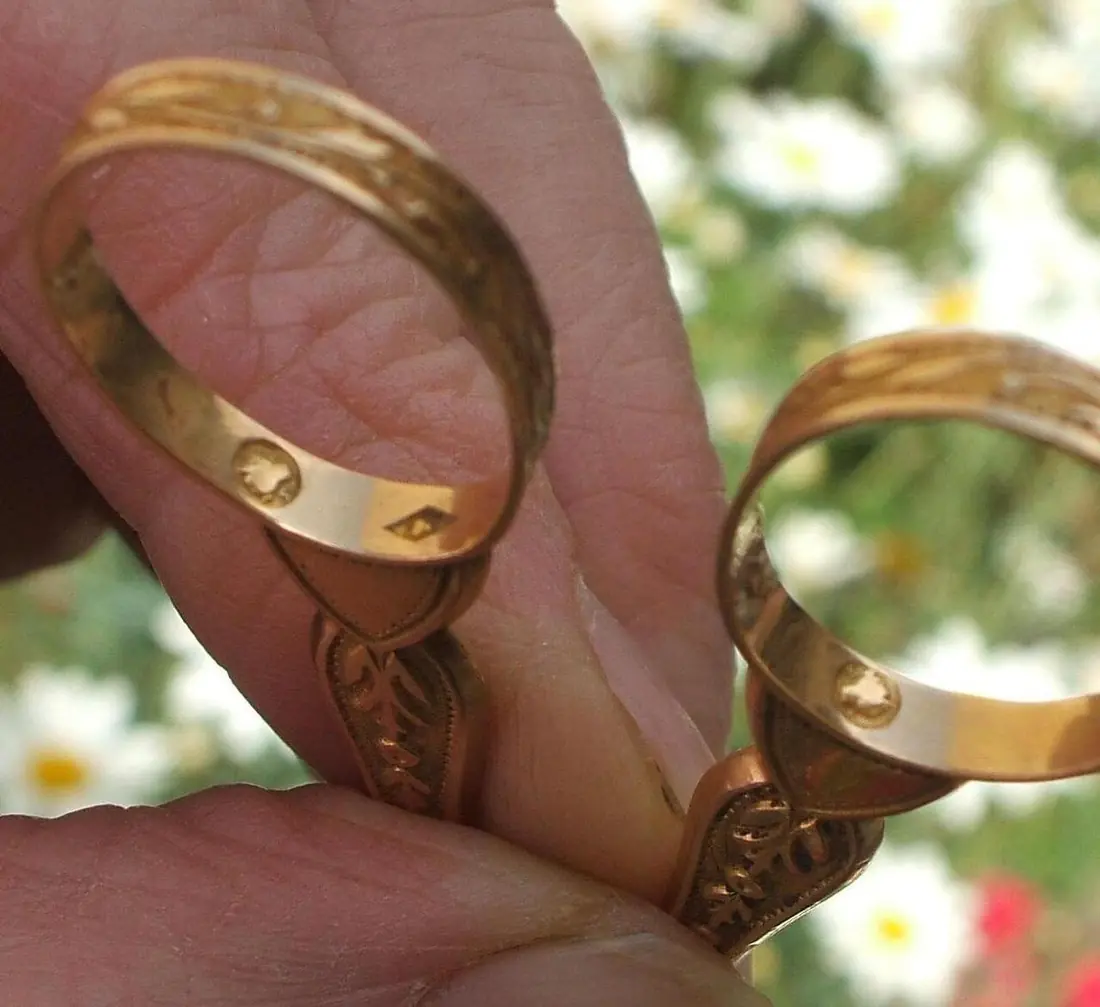
A ring almost never arrives with paperwork. It arrives in a drawer after a funeral, in a market stall under a bare bulb, or in a box at the back of a wardrobe with nobody left to ask about it. The good news is that most rings carry their own ID card — a row of stamps a millimetre tall on the inside of the band. Learn to read them and you can name the metal, the purity, often the maker, sometimes the exact year, and — most usefully — whether you’re holding solid gold or a gold-coloured shell.
Where to look, and what you need
Marks live on the inside of the shank — the band — usually opposite the stone. On a signet ring they may sit on the underside of the face. You need three things: strong light, a 10x loupe or a phone camera zoomed all the way in, and a cloth, because decades of skin oil turn crisp stamps into mush. Photograph the band and pinch to zoom on the screen; it is far easier than squinting.
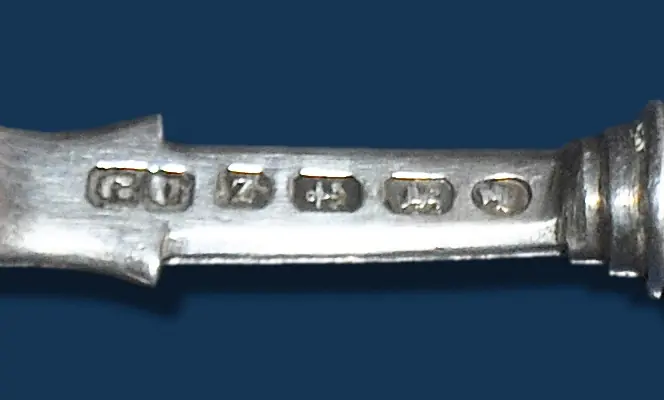
Anatomy of a hallmark row
A true hallmark isn’t one stamp, it’s a small sentence. The row below is the British pattern, the most systematic in the world and the easiest to learn from. Tap a stamp to read what it does — or just let it walk you through.
Sponsor’s mark
The initials of the person or company that submitted the piece for hallmarking. It establishes who is responsible for the item rather than who physically made it — which is why the trade calls it a sponsor’s mark and everyone else calls it the maker’s mark.
Compulsory in the UKIn the UK the sponsor’s mark, the fineness mark, and the assay office mark are the compulsory three. The pictorial standards — a crown for gold, the lion passant for sterling, an orb for platinum — and the date letter are voluntary additions, which is why plenty of modern British rings carry no date at all.
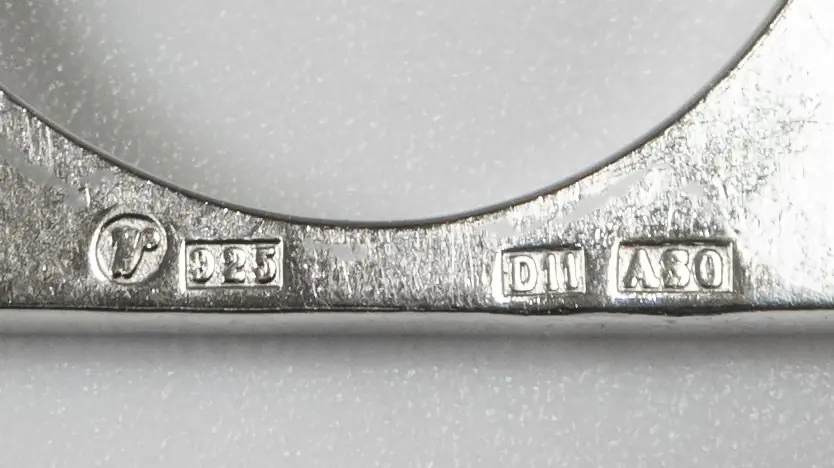
The number is the part that always tells the truth
Symbols vary by country and century. The number doesn’t. Fineness is quoted in parts per thousand: 750 means 750 parts of every thousand are gold, which is 75%, which is 18 karat. Karat is just the same fact in twenty-fourths. Once you know that, the whole gold ladder collapses into one idea.
Higher isn’t better for a ring you actually wear. 24K is butter-soft and deforms; 22K is traditional across South Asia and the Gulf; 18K is the luxury standard; 14K is the durable everyday choice; 9K is common in the UK and is more copper than gold.
Decode the stamp you’re looking at
Tap one of the common marks, or type exactly what you can see — including the odd ones like 1/20 12K GF. The decoder tells you the metal, the purity, and the only thing that really matters at first glance: whether the precious metal goes all the way through.
- Metal
- —
- Purity
- —
Every mark below is real and common. Several of them look like a precious-metal stamp and aren’t.
Rule of thumb: numbers alone (375, 585, 750, 925, 950) mean solid. Letters stuck to the number — GP, GF, GEP, HGE, RGP, EP — mean a layer on top of something cheaper.
Solid, filled, or plated — the difference is enormous
This is the single most valuable thing on the page, because it’s where money is lost. All three look identical across a table.
A useful trick: look at the bottom of the band, the part that rubs against the neighbouring finger. Plating fails there first, and a thin brassy or grey line running along the underside is a confession.
Vermeil, and other honest-but-confusing marks
- 925 on a gold-coloured ring — almost always vermeil: sterling silver with a thick gold plating. Real silver underneath, real gold on top, priced as neither.
- KP — “karat plumb”, meaning the piece assays at exactly the marked fineness rather than the small tolerance US law allows between a stamp and the metal beneath it.
- CZ, MOI, SIM — a note about the stone, not the metal. “925 CZ” is sterling silver set with cubic zirconia, and it’s a manufacturer telling you the truth.
- SS — nearly always stainless steel. Occasionally an optimistic seller means sterling silver.
- Nickel silver, German silver, alpaca — contain no silver whatsoever. The name describes the colour.
Who, where, and when: the pictorial marks
Once the number is settled, the symbols give you geography and dates. A few that come up constantly:
- Britain — a leopard’s head for London, an anchor for Birmingham, a rose for Sheffield, a castle for Edinburgh, plus a date letter whose typeface and shield shape pin the year.
- France — an eagle’s head for 18K gold (in use since 1838), a clover for 9K, Minerva’s head for 925 silver, a dog’s head for 950 platinum. French marks are tiny and often struck half off the edge.
- Import and convention marks — a separate stamp showing a piece was assayed in another country and legally sold locally. It doesn’t lower the fineness; it just tells you the passport route.
An unmarked ring is not a fake ring. Resizing removes marks, decades of polishing wears them flat, and vast quantities of perfectly good gold were made in places and periods that never stamped anything.
When there is nothing stamped at all
Roughly in order of how much they tell you, and how much they risk — each one is covered step by step in how to tell if a ring is real gold:
- Magnet. Gold, silver and platinum are not attracted to a magnet. A firm pull means a steel core — though springs and hidden components can fool you on complex pieces.
- Heft. Precious metals feel wrong-heavy for their size. Platinum is dramatically denser than white gold, and a plated brass ring feels like a toy once you’ve held the real thing.
- Your skin. A green or grey line on the finger means copper is in contact with you — either a low-karat alloy reacting, or plating that has worn through.
- Wear patterns. Look for two-tone edges where a thin layer has rubbed away, and for solder seams from a past resizing, which are also where marks usually vanished.
- XRF at a jeweler. An X-ray fluorescence gun reads the alloy in seconds, doesn’t scratch anything, and most jewelers and gold buyers will do it in front of you. This is the answer, not a guess.
- Acid testing. Accurate and cheap, but it needs a small scratch on the piece. Fine for scrap, wrong for anything you might keep.
Not sure what you’re holding? Ring Identifier scans a whole piece — band, setting and stones — for a quick read on what it likely is, and Diamond Identifier AI focuses on the centre stone. Treat both as a fast first opinion that tells you whether the trip to a jeweler is worth making, not as a substitute for a certified appraisal.
Read the setting and stones too
Marks describe metal, not craftsmanship, and the rest of the ring dates itself. Hand-cut stones with tiny facet irregularities, closed-back settings, and knife-edge shanks point to genuinely old work; laser-straight pavé and perfectly uniform melee point to modern machine production. If there’s a centre stone, the way it’s held is its own body of evidence — see what each setting actually does and, if you suspect the stone rather than the band, the home tests for a real diamond.
- Look here first
- Inside the shank, opposite the stone
- Solid gold
- 375, 417, 585, 750, 916 — or 9K to 22K
- Not solid
- Anything with GP, GF, GEP, HGE, RGP, EP
- 925
- Sterling silver — gold colour means vermeil
- Platinum
- PT, PLAT, 950, 900, sometimes an orb
- No marks?
- Inconclusive. Get an XRF reading
The takeaway
Ninety percent of identifying a ring is one habit: clean the inside of the band, magnify it, and read the number before you form an opinion. The number gives you the metal and the purity, the letters beside it warn you when the gold is only skin deep, and the symbols hand you a country and often a year. Everything after that — who made it, what the stones are, what it’s worth — is a much shorter conversation once you can say “this is a 750 band with a Birmingham anchor” instead of “this is a gold-ish ring”.
At a glance
| Stamp | Meaning |
|---|---|
| 375 / 9K | 37.5% gold |
| 417 / 10K | 41.7% gold |
| 585 / 14K | 58.5% gold |
| 750 / 18K | 75% gold |
| 916 / 22K | 91.6% gold |
| 925 / STER | Sterling silver (92.5%) |
| 950 / PT950 / PLAT | Platinum (95%) |
| GP, HGE, RGP, GF, 14K/20 | Gold plated, electroplated, rolled or filled — not solid |
| Vermeil | Gold over sterling silver |
Frequently asked questions
What does 585 mean on a ring?
It means the metal is 58.5% pure gold — 14 karat.
Does no stamp mean my ring isn’t real gold?
Not necessarily. Older rings, resized rings and pieces from some countries may lack stamps. A jeweler can test the metal with acid, an electronic tester or XRF.
What is a hallmark?
An official mark applied by an independent assay office after testing precious metal. In the UK hallmarking is required by law above certain weights, and a hallmark includes a sponsor’s mark, a fineness mark and an assay office mark.
Can a stamp be faked?
Yes. Karat stamps are applied by makers and can be false; independent hallmarks are more trustworthy. Magnet, acid and electronic tests help confirm.
Sources and further reading
- Hallmarking — The Goldsmiths’ Company Assay Office (London)
- Hallmarking information — The Birmingham Assay Office
- Hallmarking Act 1973 — legislation.gov.uk
- 16 CFR Part 23 — Guides for the Jewelry, Precious Metals, and Pewter Industries — U.S. Electronic Code of Federal Regulations
- Hallmark — Wikipedia
Links checked September 14, 2026.
Explore the apps
34 fast, fun, AI-powered apps with 1M+ on the App Store. Find your next favorite.
Browse all apps