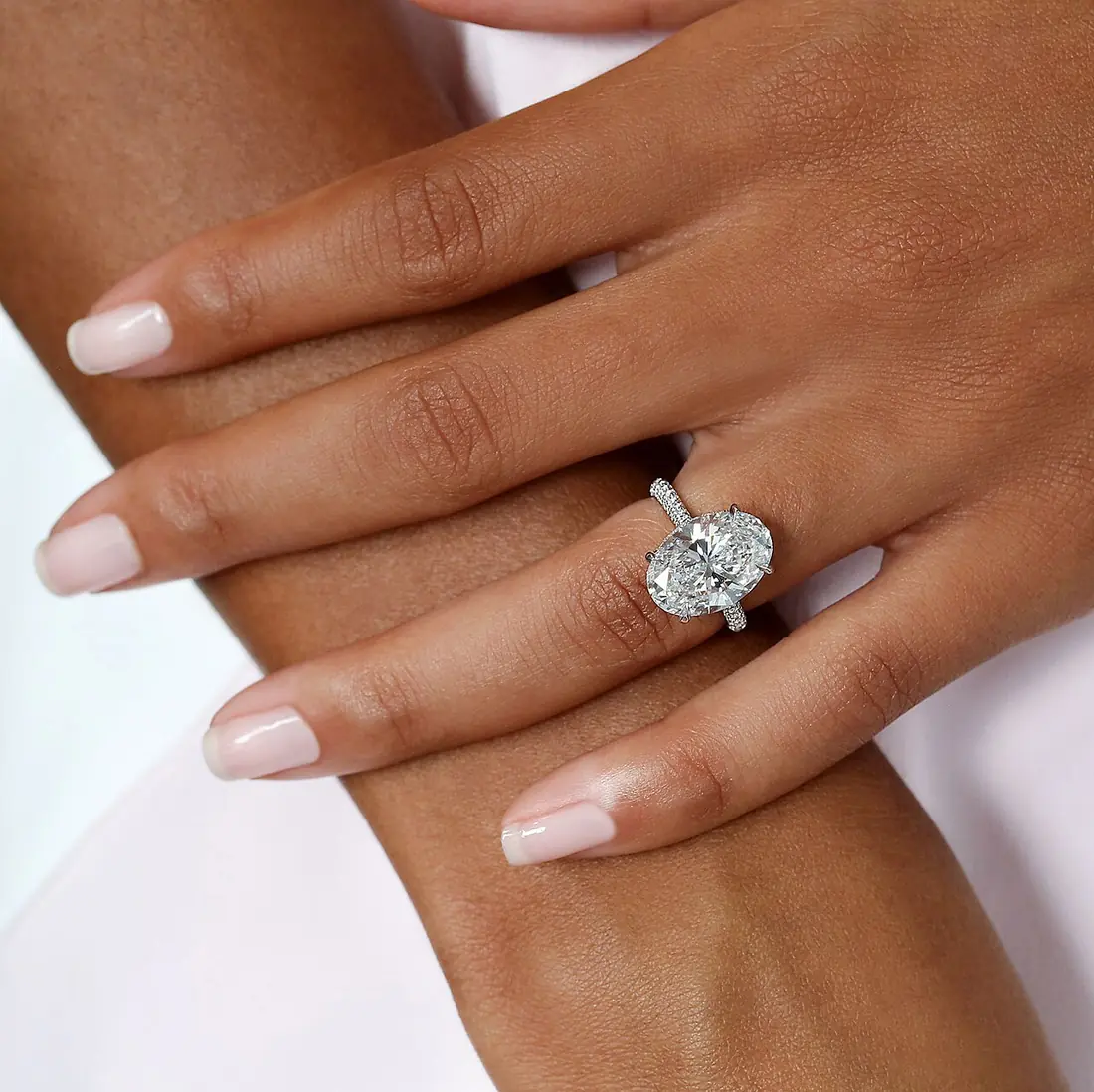
Shoppers spend weeks agonizing over the 4 Cs and about ten minutes on the setting — which is backwards. The setting decides how large the diamond reads on a hand, how much light gets underneath it, whether it survives a decade of doors and sleeves, and often a serious chunk of the total price. The same one-carat stone can look modest or enormous depending on how it’s mounted. Here’s what each setting actually does.
First, the vocabulary
Two words get mixed up constantly. The setting is how the stone is held — prongs, a metal rim, channels, and so on. The mounting or head is the whole structural piece the stone drops into, and the shank is the band itself. A jeweler quoting you “setting only” means everything except the center diamond, so always confirm what’s included in a price.
Prong: the classic
Thin metal claws grip the stone, usually four or six of them. Prongs hold the diamond up and away from the band, so light enters from every direction — this is the most brilliant option and the reason the solitaire has never gone out of style. Four prongs show more of the stone and give a squarer look; six prongs cover a little more but are meaningfully more secure. The trade-off is exposure: raised prongs snag on knits and can bend, so they need checking every year or two.
Bezel: the workhorse
A continuous metal rim wraps the diamond’s edge. Nothing sticks out, nothing catches, and the girdle — the most chip-prone part of a stone — is fully protected. It’s the setting of choice for nurses, climbers, parents of small children, and anyone who works with their hands. Two things to know: a bezel blocks some side light, so the stone can look a touch darker, and a full bezel makes the diamond read slightly larger while a half bezel (metal on two sides only) splits the difference.
Halo: the size illusion
A ring of small diamonds circles the center stone. Done well, a halo can make a 0.75-carat diamond present like something well over a carat, which is why it remains the best value-per-visual-impact setting on the market. The catch is maintenance and honesty: dozens of tiny stones mean dozens of tiny prongs to keep an eye on, and if the halo stones are noticeably whiter than the center, they’ll make the main diamond look tinted. Match the colour grades.
A setting is the only part of a ring you can change later — but it’s also the part that decides how often the diamond needs a jeweler’s attention. Choose it for your hands, not just for the photograph.
Pavé and channel: the sparkling band
Both scatter small diamonds along the shank. Pavé sets them close together in tiny beads of metal so the band looks paved with light; micro-pavé takes that to an extreme with even smaller stones. Channel setting drops stones between two metal walls, flush and protected, with no beads to catch. Pavé sparkles more; channel is far more durable and much easier to keep clean. Note that heavily pavé’d bands are hard to resize, so get the fit right the first time.
Tension, cathedral, and the rest
- Tension — the stone appears suspended, held by the spring pressure of the band. Striking and modern, but nearly impossible to resize and it demands a very tough stone.
- Cathedral — arches of metal rise from the band to the head, adding height and support without covering the diamond.
- Three-stone — a center diamond flanked by two side stones; more finger coverage and a strong vintage look.
- Flush or gypsy — the stone sits sunk into the band itself. The most snag-proof setting there is, and the least sparkly.
- Cluster — many smaller stones arranged to read as one larger shape; big visual impact for a small budget.
Metal matters more than people expect
Platinum is dense and holds prongs securely for decades, and it never needs re-plating — the reason most jewelers recommend it for the head even when the band is gold. White gold is lighter on the budget but is rhodium-plated, so it warms up over the years and needs re-dipping. Yellow and rose gold are beautiful, but yellow metal reflects into a stone, which can make a near-colourless diamond look warmer — a real advantage if you deliberately bought a lower colour grade.
Matching the setting to the stone
- Lower colour grade (I–K)? Yellow or rose gold hides the tint. A platinum solitaire will advertise it.
- Visible inclusion? Position a prong over it, or choose a halo to draw the eye outward.
- Emerald or Asscher cut? Those cropped corners are vulnerable — bezel or prongs directly on the corners.
- Marquise or pear? The pointed tips chip easily and need a V-shaped prong.
- Active hands? Bezel or flush, and keep the profile low.
Trying to work out what a ring in front of you is worth? Ring Identifier scans a full piece — stone, setting, and metal — for a quick read, and Diamond Identifier AI focuses on the center stone’s cut, colour, and estimated value. Useful before you negotiate, not a replacement for a certified appraisal.
- Most brilliant
- Prong solitaire — light from every side
- Most secure
- Bezel or flush setting
- Best size illusion
- Halo, then cluster
- Hardest to resize
- Tension and full-pavé bands
- Maintenance
- Check prongs every 1–2 years
The takeaway
Pick the setting for the life the ring will live. Prongs give you maximum sparkle, bezels give you peace of mind, halos give you visual size for less money, and pavé gives you light along the whole band at the cost of easy resizing. Then use the metal and the setting together to flatter the stone you actually bought — the right mounting can make a modest diamond look like a considerably more expensive one, which is the cheapest upgrade in the case.
At a glance
| Setting | Security | Sparkle | Upkeep | Resizable |
|---|---|---|---|---|
| Four / six prong | Good (six better) | Highest | Check prongs yearly | Yes |
| Bezel | Best | Slightly less | Low | Yes |
| Halo | Good | Looks larger | Small stones can loosen | Usually |
| Pavé band | Moderate | High | Stones can loosen | Limited |
| Channel | Good | Moderate | Low | Limited |
| Tension | Depends on maker | High | Specialist repair | Rarely |
Frequently asked questions
What is the most secure diamond setting?
A full bezel, where metal surrounds the whole girdle of the stone, protects it best against knocks and snagging.
Are four prongs or six prongs better?
Six prongs hold the stone more securely and keep it in place if one prong breaks; four prongs show more of the diamond and can make it look slightly larger and squarer.
Does a halo make a diamond look bigger?
Yes. A ring of small diamonds around the center stone increases the visual diameter. It also adds cost, because every accent stone has to be set.
How often should prongs be checked?
Have a jeweler inspect prongs about once a year, and sooner if the ring snags on clothing or you notice the stone moving.
Sources and further reading
- Diamond Description — GIA
- Diamond cut — Wikipedia
Links checked September 14, 2026.
Explore the apps
34 fast, fun, AI-powered apps with 1M+ on the App Store. Find your next favorite.
Browse all apps