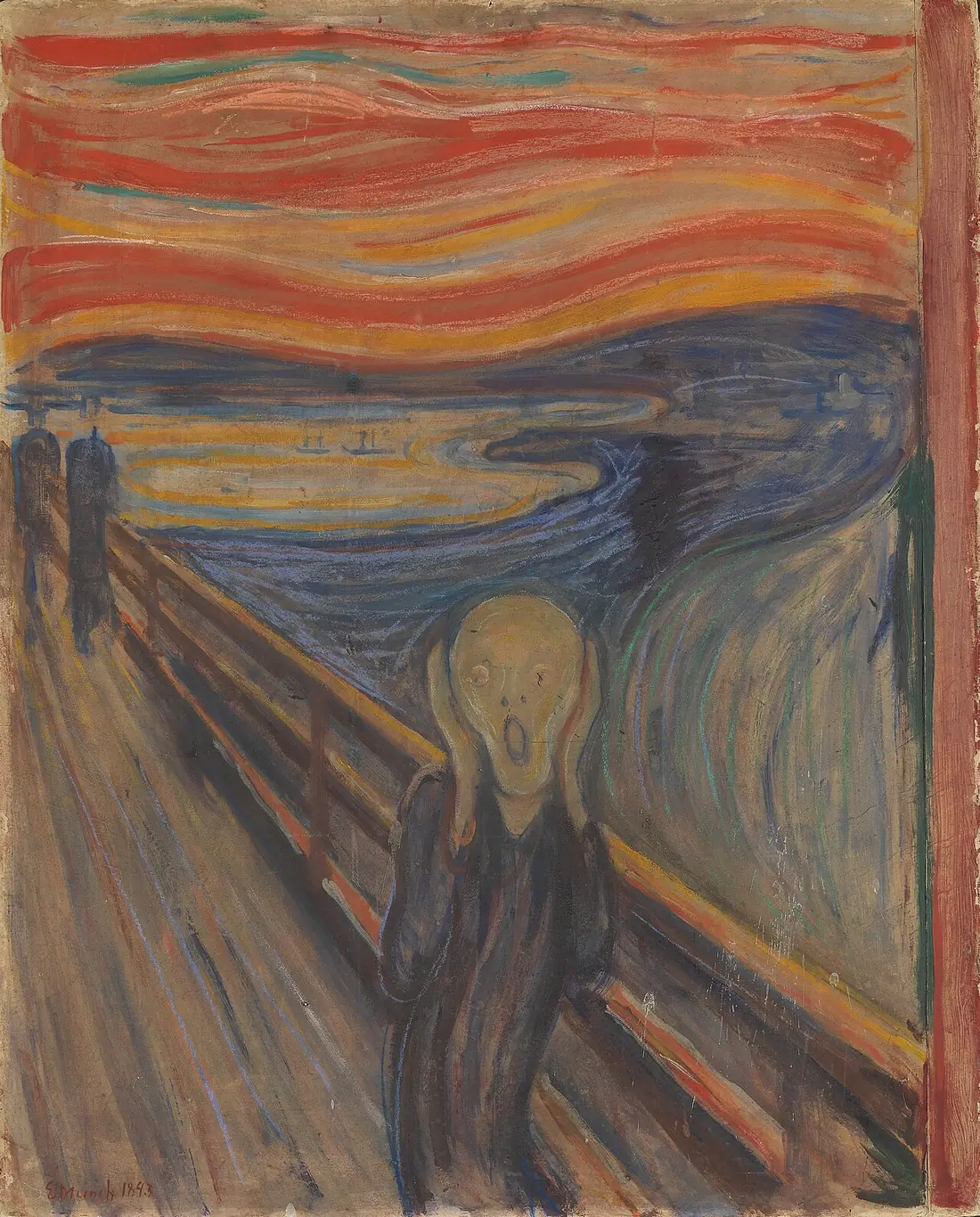
A skull-like face, hands pressed to its cheeks, mouth open under a sky the color of fire — Edvard Munch’s The Scream has become the universal shorthand for anxiety and dread. It’s been printed on everything from posters to emoji. But the real painting is stranger and more personal than the cliché suggests, and its history includes two brazen museum heists.
The walk that inspired it
Munch said the idea came from a real moment. Walking with friends at sunset near Oslo, he felt suddenly exhausted and saw the sky turn "blood red." He wrote that he sensed "an infinite scream passing through nature." The figure in the painting isn’t screaming — it is covering its ears against that scream, frozen in overwhelming dread. The original Norwegian title is Skrik, "The Scream of Nature."
Why the sky is on fire
Art historians have long debated the lurid orange-red sky. One popular theory links it to the spectacular sunsets seen worldwide after the 1883 eruption of Krakatoa, which filled the atmosphere with ash. Others point to rare "mother-of-pearl" clouds visible over Norway. Whatever the cause, Munch transformed an unsettling sky into a landscape of pure emotion.
Not one painting, but four
There isn’t a single Scream. Munch made four versions between 1893 and 1910 — two in paint, two in pastel — plus a lithograph that let the image spread widely. The versions are split mainly between the National Museum and the Munch Museum in Oslo. One pastel version sold at auction in 2012 for nearly $120 million, a record at the time.
Munch wasn’t painting a person in pain. He was painting the feeling itself — which is exactly why the image fits every age’s anxieties.
Stolen twice
The painting’s fame made it a target. In 1994 a version was stolen from Norway’s National Gallery during the Winter Olympics; the thieves left a note thanking the museum for its poor security. It was recovered months later. In 2004, armed robbers seized another version straight off the wall of the Munch Museum in daylight. That one was missing for two years before police recovered it in 2006. Both heists only deepened the work’s legend.
- Artist
- Edvard Munch
- First version
- 1893
- Original title
- Skrik — "The Scream of Nature"
- Movement
- Expressionism / Symbolism
- Home
- National Museum & Munch Museum, Oslo
Want to know what a painting is? Art & Painting Identifier reads a single photo to suggest the artist, title, and style, and Art Identifier Museum Guide turns a museum visit into a guided experience.
The takeaway
The Scream endures because Munch painted an emotion rather than a scene. A blood-red sky, a faceless figure, and a feeling everyone recognizes made it the world’s most universal image of anxiety — and one of the most coveted, and stolen, paintings in history.
At a glance
| Fact | Detail |
|---|---|
| Artist | Edvard Munch |
| Versions | Four (1893–1910): two paintings, two pastels, plus a lithograph |
| Original title | Skrik; German “Der Schrei der Natur” |
| Best-known version | 1893, tempera and crayon on cardboard |
| Movement | Expressionism / Symbolism |
| Locations | Nasjonalmuseet and the Munch Museum, Oslo; one pastel privately owned |
| Thefts | 1994 (National Gallery) and 2004 (Munch Museum); both recovered |
Frequently asked questions
Is the figure in The Scream screaming?
Munch’s own account suggests the figure is reacting to a scream passing through nature, covering its ears, rather than screaming itself.
How much did The Scream sell for?
A 1895 pastel version sold at Sotheby’s New York in 2012 for about $120 million, then a record for a work at auction.
Why is the sky red in The Scream?
Theories include vivid sunsets after the 1883 Krakatoa eruption and nacreous clouds over Oslo, but Munch framed it as an emotional experience.
How many times has The Scream been stolen?
Twice: a version was taken from Norway’s National Gallery in 1994 and another from the Munch Museum in 2004. Both were recovered.
Sources and further reading
- Edvard Munch, The Scream (1893) — Nasjonalmuseet, Oslo
- The Scream — Wikipedia
Links checked September 14, 2026.
Explore the apps
34 fast, fun, AI-powered apps with 1M+ on the App Store. Find your next favorite.
Browse all apps