 🖼️ AI Tools
Art Scan: Painting Identifier
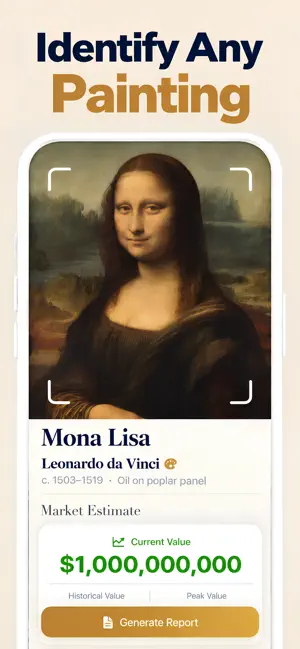
Identify a painting and learn its story with a single photo.
Built by Abdullah Yılmaz
Art Scan: Painting Identifier uses AI to recognize artworks and paintings from a photo, surfacing the likely artist, title, style, and historical context. It turns your camera into a pocket art guide for museums, galleries, estate sales, and flea-market finds.
Snap a picture of a painting and the app tells you what it’s looking at and why it matters — useful whether you’re standing in front of a masterpiece or trying to make sense of a piece you found in the attic.
Screenshots

What it does
Instant recognition
Identifies likely artist, title, period, and art movement from a single snap.
Context and story
Gives key facts about a work — its history and why it matters.
Museum companion
Learn about what you’re seeing without hunting for a wall label or tour guide.
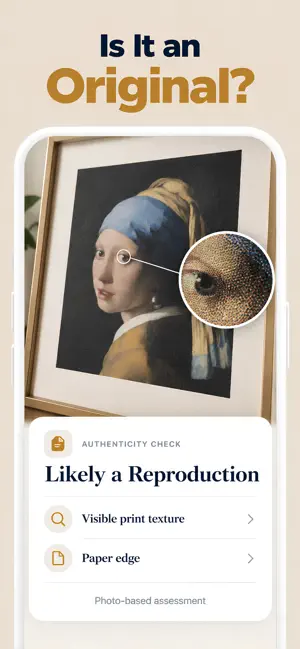
Original-or-Fake screening
An AI authenticity estimate with the red flags behind it, to guide what you verify next — a screening, not a certification.
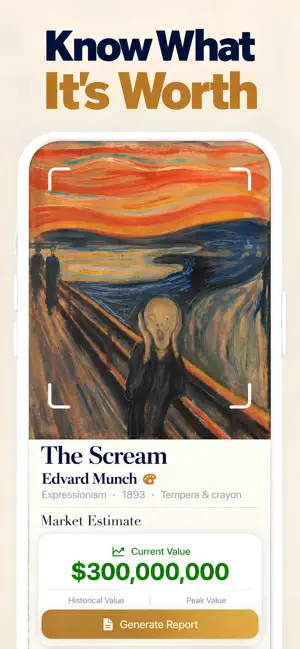
Price insights
An estimated price range when market data exists — a starting point, not an appraisal.
Similar works and collection
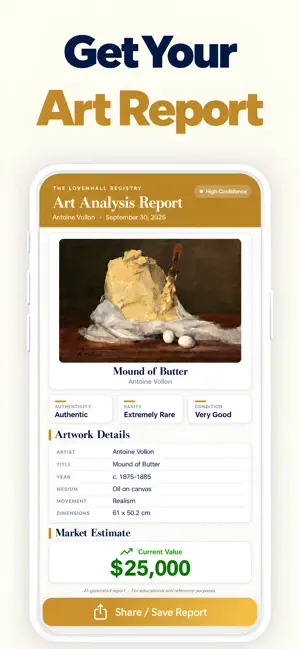
Compare visually related paintings and save your scans to revisit later.
How to identify a painting in four steps
-
Take a straight, glare-free photo
Stand square to the picture, avoid flash and reflections from glass, and include the whole image. Add close-ups of the signature and the back.
-
Scan it
Art Scan suggests the artist, title, movement and period with key facts about the work, estimates a price range when market data exists, and lists the red flags its Original-or-Fake screening found.
-
Check painting vs print
Use a 10× loupe and light from the side. Dots, a grid or a speckled pattern mean a print — a cheap reproduction or a signed original print. Texture alone proves little: some reproductions add brushstroke texture or hand-applied paint over the print. Check the back for labels and stamps.
-
Research before you value
Note labels, stamps and inscriptions on the back. Compare auction results for similar works by the artist — size, medium, date, provenance and condition all move the price — and ask a specialist or an independent appraiser about anything that might be valuable.
When to use it
- You’re at a museum or gallery and want the story behind a painting on the spot.
- You found a painting at an estate sale and want to know who might have made it.
- You’re researching a piece you inherited and don’t know where to start.
- You’re an art student or enthusiast building visual knowledge.
What a photo scan can and can’t tell you about a painting
| Question | From a photo | Needs an expert or in-person look |
|---|---|---|
| Famous artwork — title and artist | A suggested match | Check it against the museum’s collection record |
| Style, movement and approximate period | A suggestion to check | Exact date |
| Unknown or amateur artist | Style and period clues | Attribution |
| Original, print or reproduction | Clues only | Loupe, side light and the back; a specialist for valuable work |
| Authenticity | A screening: an AI estimate and red flags to check, not a verdict | Specialist opinion, provenance, technical analysis |
| Value | An estimated price range when market data exists | Appraisal based on an in-person inspection and comparable sales |
Frequently asked questions
Can it tell me if my painting is valuable?
It gives an estimated price range when market data exists — a starting point, not an appraisal. Value depends on provenance, condition, medium, size and demand, so a formal valuation still needs a qualified appraiser who sees the work.
Does it work on lesser-known or amateur paintings?
It’s strongest on known artists and recognizable styles. For obscure or amateur works it can still suggest the style and period to guide further research.
Can it distinguish an original from a print?
Its Original-or-Fake screening flags signals and inconsistencies to check, but it is not a certification. Confirming an original vs. a print or reproduction usually needs a close in-person inspection. Our blog covers how to check.
Which devices does it run on?
It’s free to download from the App Store for iPhone and from Google Play for Android, with in-app purchases — on the App Store, weekly, monthly or yearly subscriptions and credit packs.
Is there an app that identifies paintings from a photo?
Yes. Art Scan: Painting Identifier suggests the artist, title, style and period from a photo, with key facts about the work, an estimated price range when market data exists and an Original-or-Fake screening. It is free to download for iPhone and Android, with in-app purchases.
Can a painting identifier tell if my painting is an original?
Not on its own. Art Scan’s Original-or-Fake screening gives an AI estimate and the red flags behind it, but it is a screening, not a certification, and a photo can’t reliably separate a painting from a good print — some prints even carry added texture or hand-applied paint. Look under a 10× loupe for printed dots, check the back, and for a valuable work ask a specialist.
How do I find out what my painting is worth?
Use the app’s estimated range as a starting point, then confirm the artist and compare recent auction results for similar works — auction houses weigh size, medium, date, provenance, rarity and condition. For insurance, an estate or a donation, hire an independent appraiser who won’t offer to buy the work or charge a percentage of its value. To sell, auction houses also give free preliminary estimates.
Does it work in museums?
Yes, where photography is allowed. Photograph a work without flash to get its title, artist and key facts without searching for the wall label. Scans need an internet connection, and some museums bar photos of certain loaned works, so follow the gallery signs.
Sources and further reading
- Art Scan: Painting Identifier (App Store listing, US, version 2.5 of 31 October 2026) — Apple App Store
- Art Scan: Artwork Identifier (Google Play listing, updated 8 October 2026) — Google Play
- How to Tell a Print from a Painting (2017) — The RealReal (reseller)
- What is an Original Print? — Print Council of America
- Is My Painting Real? How to Tell if You Have an Original or a Print (12 February 2026) — The Fine Art Restoration Company (conservators)
- Visual Identification Guide: Image Structure (at 10× magnification) — Image Permanence Institute, Rochester Institute of Technology
- Giclée — Wikipedia
- Thomas Kinkade — Wikipedia
- How is an artwork appraised? (2020) — Christie’s (auction house)
- How are estimates determined? (updated 1 October 2026) — Sotheby’s Help Center (auction house)
- Glossary: Appraisal, Estimate — Sotheby’s (auction house)
- FAQs for Consumers — American Society of Appraisers
- Getty Provenance Index — Getty Research Institute
- Provenance — Wikipedia
- Visitor policies (photography) — Art Institute of Chicago
Links checked November 15, 2026.
Related reading
The Art Guide: Identify, Authenticate, Value and Care for Paintings — every guide on the topic, in reading order.
Try Art Scan: Painting Identifier
Identify artworks and paintings with a single snap.