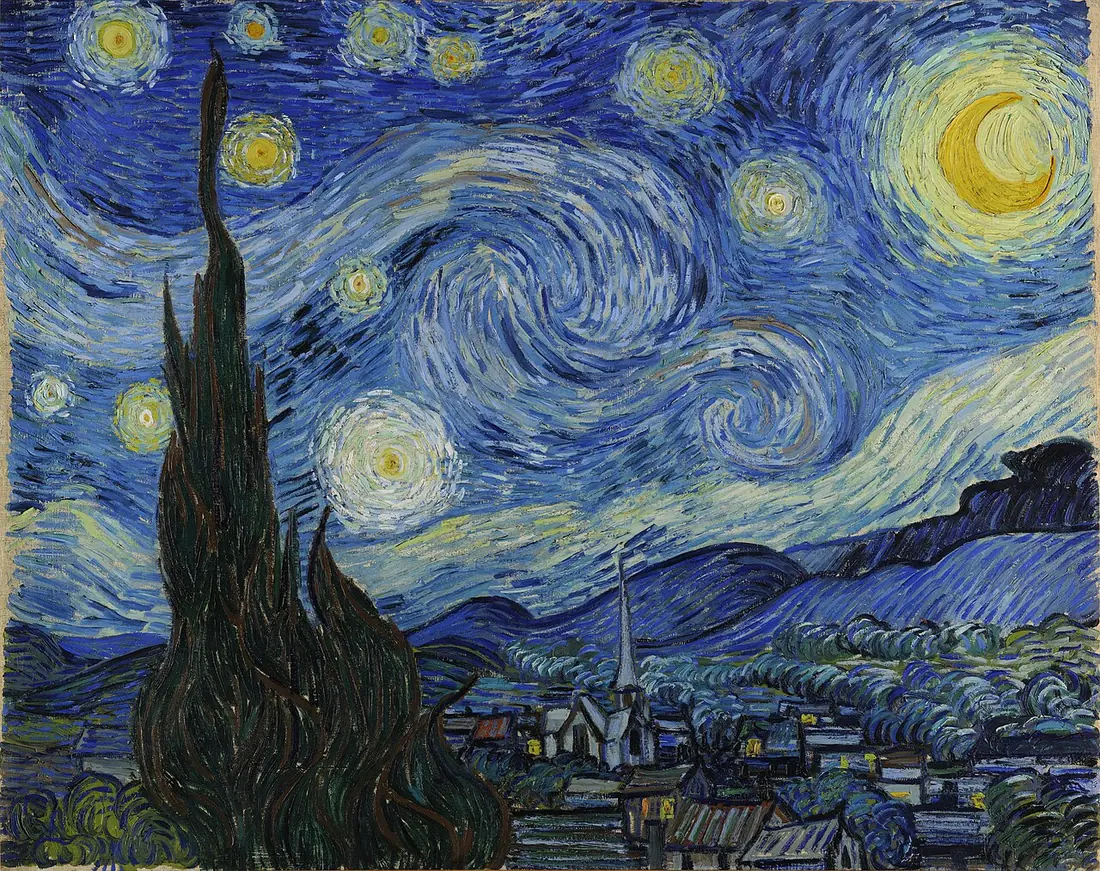
A village asleep under a sky that churns like a river of light — Vincent van Gogh’s The Starry Night is one of the most recognized images ever painted. What few people realize is that he painted it from the window of a room in an asylum, during one of the most fragile years of his life, and that he himself was unsure it was any good. Here’s the story behind the swirls.
Painted from a window
In 1889 Van Gogh voluntarily entered the asylum of Saint-Paul-de-Mausole in Saint-Rémy-de-Provence, in southern France, after a breakdown. From the east-facing window of his room he could see the rolling hills and the dawn sky. The Starry Night is his vision of that view just before sunrise — though he added the village church spire and other touches from memory and imagination.
A sky that moves
The painting’s power comes from its restless motion. Van Gogh applied paint in thick, swirling strokes — a technique called impasto — so the surface itself has texture and direction. The sky rolls in great spirals, the stars and moon blaze with halos of yellow, and the dark cypress tree in the foreground rises like a flame. Nothing is still; the whole night feels alive.
"This morning I saw the countryside from my window a long time before sunrise, with nothing but the morning star, which looked very big." — Van Gogh, writing to his brother Theo.
The cypress and the village
The towering cypress that connects earth and sky was, in Van Gogh’s time, associated with mourning and graveyards — yet here it seems to reach upward with energy rather than grief. The peaceful village below, with its small church, is partly invented; the real view had no such town. The contrast between the calm earth and the turbulent heavens is the painting’s emotional core.
Famous only after his death
Van Gogh sold almost nothing in his lifetime and died in 1890, the year after painting it, never knowing his work would become beloved worldwide. He even dismissed The Starry Night in letters as a relative failure. Today it hangs in the Museum of Modern Art (MoMA) in New York and is considered one of the cornerstones of modern art.
- Artist
- Vincent van Gogh
- Date
- June 1889
- Medium
- Oil on canvas (impasto)
- Movement
- Post-Impressionism
- Home
- MoMA, New York
Curious about a painting’s artist or style? Art & Painting Identifier identifies an artwork from one photo — artist, title, and movement — and explains it like a personal docent.
The takeaway
The Starry Night turned private turmoil into universal beauty. Painted from a sickroom window by an artist who doubted himself, it became a symbol of how raw emotion, bold technique, and a churning imagination can outlast a lifetime — and light up the dark.
At a glance
| Fact | Detail |
|---|---|
| Artist | Vincent van Gogh |
| Date | June 1889 |
| Medium | Oil on canvas (impasto) |
| Size | 73.7 × 92.1 cm |
| Movement | Post-Impressionism |
| Painted at | Saint-Rémy-de-Provence, France |
| Location | The Museum of Modern Art (MoMA), New York |
Frequently asked questions
Where is The Starry Night painting?
At the Museum of Modern Art (MoMA) in New York, which acquired it in 1941.
Is the village in The Starry Night real?
Partly imagined. The view from his window was real, but Van Gogh painted the sky and village in his studio, and the church spire resembles those of his native Netherlands.
What did Van Gogh think of The Starry Night?
He was ambivalent; in a letter to his brother Theo he called it a failure in some respects. It became famous only after his death in 1890.
Is The Starry Night the same as Starry Night Over the Rhône?
No. Starry Night Over the Rhône (1888) shows the river at Arles and hangs in the Musée d’Orsay in Paris.
Sources and further reading
- Vincent van Gogh, The Starry Night (1889) — The Museum of Modern Art
- The Starry Night — Wikipedia
Links checked September 14, 2026.
Explore the apps
Fast, fun, AI-powered apps with 1M+ on the App Store. Find your next favorite.
Browse all apps