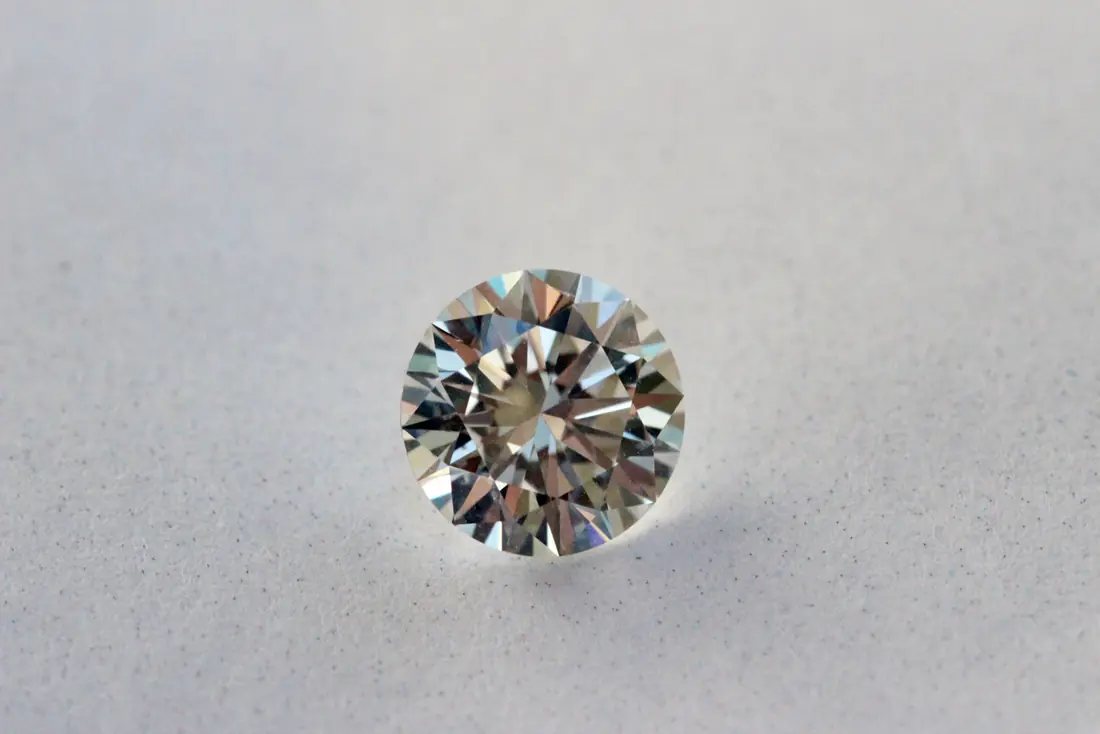
Almost everyone shopping for a diamond asks for a carat number, then spends the rest of their life looking at a millimetre number. Carat is weight — exactly 0.2 grams, sitting on a scale where nobody can see it. What you and everyone else actually notice is the width of the stone face-up on a finger. Those two things are related, but not the way the price list implies, and the gap between them is where the best value in the whole market hides.
Weight is cubic, sight is flat
Double the weight of a stone and you do not double its width. Weight grows with volume — roughly the cube of the diameter — so a 2.00 carat round is only about 26% wider than a 1.00 carat, not twice as wide. It’s the single most useful fact in diamond shopping, and it works in your favour at every price break.
Drag the slider. The circle is drawn at approximate life size, with a one-carat outline behind it for reference — so if you have a ring nearby, hold it against the screen and see what you actually own.
Widths use the standard trade estimate for a well-cut round at about 61.5% depth; real stones vary by a couple of tenths of a millimetre. On-screen scale is close on most phones and only approximate on desktop monitors — the millimetre figure is the reliable part.
Magic weights: the price cliffs
Diamonds are not priced on a smooth curve. Per-carat prices step up sharply at the round numbers people ask for — 0.50, 0.70, 0.90, 1.00, 1.50, 2.00 — because demand piles up there. Land a hair under the line and you pay the lower tier for a stone nobody can distinguish by eye.
Those percentages are fractions of a millimetre — invisible on a hand, across a table, or in a photograph. The saving on the right stone is frequently double digits, which is why the trade calls the weights just below the thresholds “shy” stones and dealers quietly love them.
Nobody has ever looked at a ring and said “that must be a 0.92”. They see width, brightness, and shape. Buy the millimetres and let someone else pay for the round number on the certificate.
Shape changes everything about size
Every outline below is one full carat. They weigh the same and they look nothing alike, because elongated shapes spread their weight across the top while square and deep shapes bury it underneath.
Typical dimensions for a one-carat stone, give or take a couple of tenths. A marquise reads enormously bigger than a princess of identical weight — and an oval is the usual compromise between visible size and a shape that doesn’t catch on everything.
Where the hidden weight goes
Two stones can both be certified 1.00 carat and differ by half a millimetre face-up. The difference is how the cutter distributed the material.
On a report, the numbers that expose this are depth % and table %, plus the simple millimetre measurements at the top of the page. For rounds, roughly 59–62.5% depth with a 53–58% table is the comfortable zone. Do the sanity check every dealer does: divide the stone’s diameter by what the weight predicts. Anything meaningfully narrow is carrying dead weight.
The total-carat-weight trap
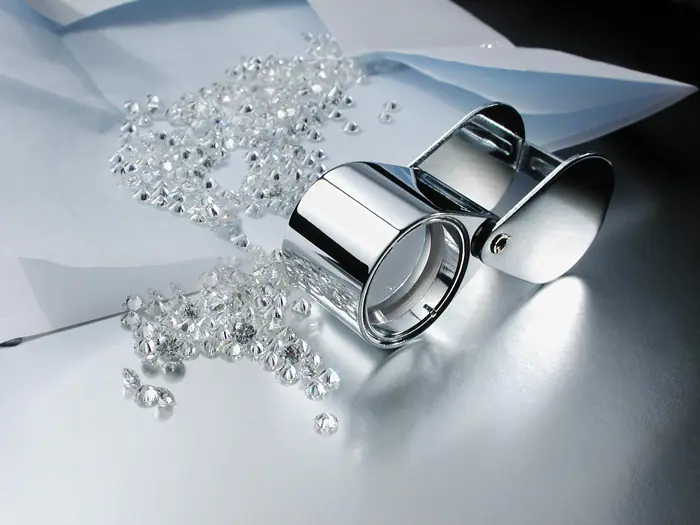
TCW or CTTW means every stone in the piece added together. A ring advertised at “1 carat total” might hold a 0.40 centre and sixty accents, and it is worth a small fraction of a single one-carat stone, because per-carat prices climb steeply with size. Whenever you see a total, ask one question: what does the centre stone weigh on its own?
Buying visible size for less
- Go shy of the magic weight. 0.90 instead of 1.00, 1.40 instead of 1.50. Fractions of a millimetre for a large discount.
- Pay for cut, not weight. A brilliant, well-proportioned stone looks bigger than a heavier dull one. Cut is the only C you can see from across a room.
- Choose an elongated shape. Oval, pear and marquise buy you millimetres for free; they also flatter the finger.
- Use the setting. A halo, a thin band, and a raised head all make the same stone read larger — see how each setting behaves.
- Drop a colour or clarity grade instead. An eye-clean SI1 in a warm setting frees up budget that shows, unlike a flawless grade that only a loupe can find.
Wondering what a stone in front of you actually is? Diamond Identifier AI reads a stone for its likely qualities and value, and Ring Identifier does the same for a complete piece of jewellery. Useful for a fast opinion before you talk numbers — a graded report is still what settles carat weight to the second decimal.
- One carat
- 0.2 grams of weight, not a size
- 1.00 ct round
- About 6.4–6.5 mm across
- 2.00 ct round
- About 8.1 mm — only ~26% wider
- Best value
- Just under a magic weight, high cut grade
- Looks biggest
- Marquise, pear, oval per carat
- Red flags
- Deep %, narrow diameter, “total carat weight”
The takeaway
Shop in millimetres and pay in carats only when you have to. Ask for the diameter alongside the weight, compare it against what the weight should give you, and buy the stone that spends its material where you can see it. Do that and you will routinely walk away with something that looks like the number above your budget — which is exactly what the trade does when it buys for itself.
At a glance
| Carat weight | Approx. diameter | Compared with 1.00 ct |
|---|---|---|
| 0.50 ct | 5.1 mm | 79% as wide |
| 0.75 ct | 5.8 mm | 91% as wide |
| 1.00 ct | 6.4 mm | — |
| 1.50 ct | 7.4 mm | 14% wider |
| 2.00 ct | 8.1 mm | 26% wider |
| 3.00 ct | 9.3 mm | 44% wider |
Frequently asked questions
How big is a 1 carat diamond in mm?
A well-cut round brilliant of 1.00 carat is about 6.4–6.5 mm in diameter. Deep or shallow cuts can move that by a few tenths of a millimetre.
Does a 2 carat diamond look twice as big as a 1 carat?
No. Its diameter is only about 26% larger and its face-up area about 60% larger, because the extra weight is spread through depth as well as width.
Which diamond shape looks biggest for its carat weight?
Marquise, pear and oval shapes spread their weight across the top and look largest. Princess, cushion and Asscher cuts carry more weight in depth and look smaller for the same carat.
What does total carat weight (TCW) mean?
Total carat weight is the combined weight of every stone in a piece. A “1 ct TW” ring may contain many small stones worth far less than a single 1 ct diamond.
Sources and further reading
- The 4Cs of Diamond Quality — GIA (Gemological Institute of America)
- Diamond Description — GIA
- Diamond cut — Wikipedia
Links checked September 14, 2026.
Explore the apps
Fast, fun, AI-powered apps with 1M+ on the App Store. Find your next favorite.
Browse all apps