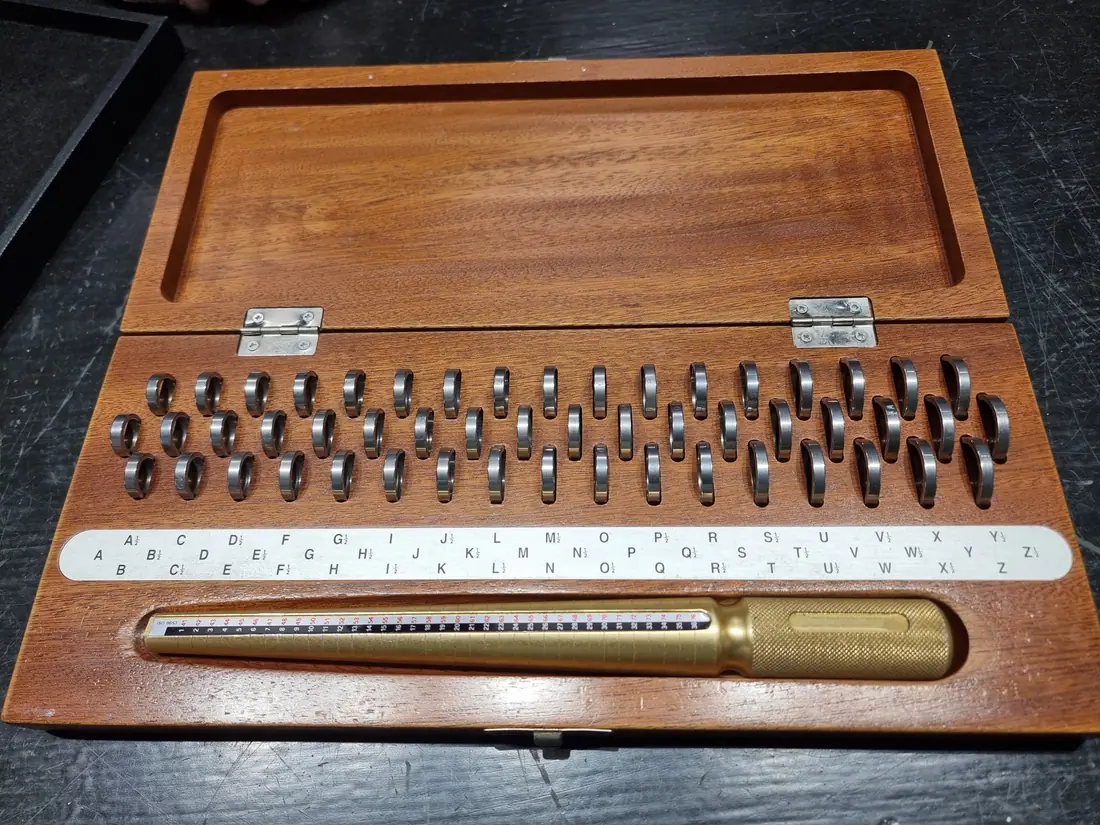
There is only one ring measurement in the world, and it is the inside of the ring in millimetres. Everything else — a US number, a UK letter, a European size in the fifties — is a different way of writing that measurement down. The US scale is arbitrary, so a size 6 is not six of anything. The UK scale is alphabetical, so it cannot be converted with arithmetic at all. Europe is the only honest one: an EU 54 is a ring measuring 54 mm around the inside. Get the millimetres right and every other system is a lookup.
Convert a measurement into every system at once
Measure the inside of a ring that already fits, or the length of a strip wrapped around the finger, and drag the slider to that number. The circle is drawn at approximate life size, so if you have the ring in your hand you can hold it against the screen as a sanity check.
US sizes follow the standard trade relationship of 2.5535 mm of inside circumference per full size. UK letters and Japanese numbers come from the published conversion charts and are shown to the nearest listed size — charts disagree by about one Japanese size at the top of the range, so treat that column as a starting point. A printed paper sizer stretches and a phone screen is not calibrated: use both as a check, never as the final answer.
Three ways to measure, in order of how much you can trust them
- A real sizer. A set of steel or plastic rings you actually put on. It is the only method that tests the thing that matters — whether the ring goes on, clears the knuckle, and comes back off. Most jewellers hand them out free, and mail-order ones cost almost nothing.
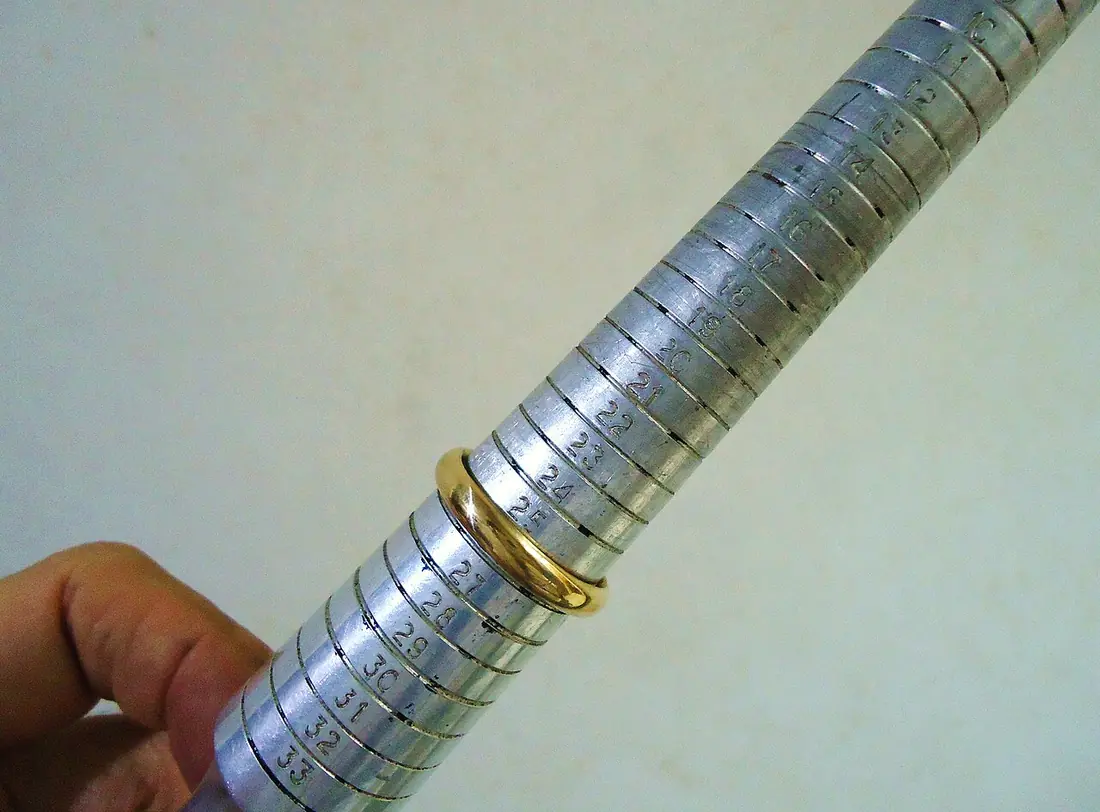
- A ring that already fits, measured properly. Digital calipers across the inside, or a mandrel. Measure the widest inside dimension and read it in millimetres. Accurate, and it works for a surprise — but only if the ring is worn on the same finger of the same hand.
- String or paper round the finger. The method everyone uses and the one that fails most often. String stretches, paper compresses, and there is no way to judge the tension. If it is all you have, use a thin strip of paper rather than thread, mark the overlap with a pen rather than a fingernail, and repeat it five times at different moments — then take the largest reading, not the average.
A millimetre either way is most of a ring size. If the ring matters — and for a wedding or engagement ring it does — the measurement deserves a proper sizer, not a piece of thread and optimism.
Fingers are not a fixed size
A single measurement is a snapshot of one finger, on one day, at one temperature. Tap what applies and watch the target move. The point is not the exact arithmetic; it is that a ring measured at the wrong moment will be wrong for the rest of its life.
Nothing selected. This is the size you would order — measured at room temperature, in the middle of an ordinary day, on the hand the ring will actually live on.
These shifts are bench rules of thumb rather than clinical measurements, and they do not stack neatly in real life. Use them as a reason to measure three times on three different days, which is the actual advice hiding inside the widget.
The knuckle is the real constraint
A ring has to pass the knuckle and then sit on a narrower base. If your knuckle is noticeably wider, measure both places and choose something between them — closer to the knuckle if the gap is large, because a ring that will not go on cannot be worn at any price. If the gap is severe, the fix is mechanical rather than numerical: sizing beads soldered inside the shank, a small horseshoe insert, or a hinged shank that opens. Ask before you buy, because not every setting will take them.
The opposite problem is a loose ring spinning and the stone hanging sideways. That is also a beads-and-inserts conversation, and it is much cheaper than a full resize.
Band width changes the size you need
A wide band covers more finger, grips more of it, and fits tighter at the same nominal size. From roughly 6 mm and up, go half a size larger, and always size in the width you actually intend to buy — measuring with a 2 mm sizer and ordering an 8 mm band is one of the most common mail-order mistakes there is.
Comfort fit works the other way. The inside is domed rather than flat, so it slides over the knuckle with less resistance and often needs half a size smaller than the same width in a flat-interior band. Two rings can share a size stamp and fit completely differently.
Some rings can never be resized
This is the part worth knowing before you choose a design, because it is the difference between a fifty-dollar adjustment and a ring you cannot wear in ten years' time.
If you love an eternity band, buy it as a second ring once the size has settled — not as the ring you commit to at the start. More on how each design behaves in diamond ring settings explained and which metal to choose.
If it has to be a surprise
- Borrow a ring she already wears on the correct finger of the correct hand, and measure the inside with calipers. This is far and away the most reliable route.
- Trace the inside, not the outside. Sit the ring on paper and draw round the inner edge, or press it into a bar of soap. Tracing the outside adds the band thickness twice and puts you a full size out.
- Ask someone who can ask. A sister, a friend, a mother. One awkward conversation beats a ring that does not go on.
- Fall back on the averages knowingly. US 6 to 7 is the most common range for women and 9 to 10 for men. It is a guess, and it is wrong often enough that you should plan on a resize.
- Buy slightly large, and check the design can be taken in. Loose is a bench job. Too small on an eternity band is a new ring.
Not sure what you already own? Ring Identifier: Jewelry AI reads a photograph of a piece for its likely metal, stones and character, and the Engagement Ring Designer lets you set a band width and US size and see the design before anyone cuts metal. For the size itself, nothing beats a physical sizer on a real finger.
- Universal unit
- Inside diameter or circumference in mm
- One US size
- 2.55 mm around, 0.81 mm across
- EU / ISO size
- The inside circumference itself
- UK sizes
- Letters — a lookup, never a formula
- Best time to measure
- Room temperature, late in a normal day
- Wide bands
- 6 mm and up: add half a size
- Between sizes
- Take the larger one
- Never resizable
- Eternity, tension, tungsten, ceramic
The takeaway
Measure in millimetres, three times, on three different days, at the width you are actually buying, on the hand the ring will live on. Convert once at the end. If you land between two sizes take the larger, and before you fall for a design, ask the one question that decides whether the ring can grow old with the person wearing it: can this be resized at all?
At a glance
| US / Canada | Inside diameter | Circumference | EU / ISO | UK / AU | Japan |
|---|---|---|---|---|---|
| 5 | 15.7 mm | 49.3 mm | 49 | J½ | 9 |
| 6 | 16.5 mm | 51.9 mm | 52 | L½ | 12 |
| 7 | 17.3 mm | 54.4 mm | 54 | N½ | 14 |
| 8 | 18.1 mm | 57.0 mm | 57 | P½ | 16 |
| 9 | 18.9 mm | 59.5 mm | 60 | R½ | 18 |
| 10 | 19.8 mm | 62.1 mm | 62 | T½ | 20 |
| 11 | 20.6 mm | 64.6 mm | 65 | V½ | 23 |
Frequently asked questions
What is the most common women’s ring size?
In the United States, sizes around 6 to 7 are most common for women and around 9 to 10 for men, but fingers vary widely — measure rather than guess.
Is it better to size up or down if I’m between sizes?
Size up. A slightly loose ring is comfortable and can be fitted with sizing beads; a tight ring is uncomfortable and hard to remove over the knuckle.
How accurate are printable ring sizers and string methods?
They are the least reliable. String and paper stretch and are hard to read to a millimetre. Measuring a ring that already fits, or using a jeweler’s metal sizer in the band width you plan to buy, is far more accurate.
Which rings can’t be resized?
Full eternity bands, most tension settings, many titanium, tungsten and ceramic rings, and rings with continuous patterns or channel-set stones all the way round are difficult or impossible to resize.
Sources and further reading
- Ring size — Wikipedia
Links checked September 14, 2026.
Explore the apps
34 fast, fun, AI-powered apps with 1M+ on the App Store. Find your next favorite.
Browse all apps