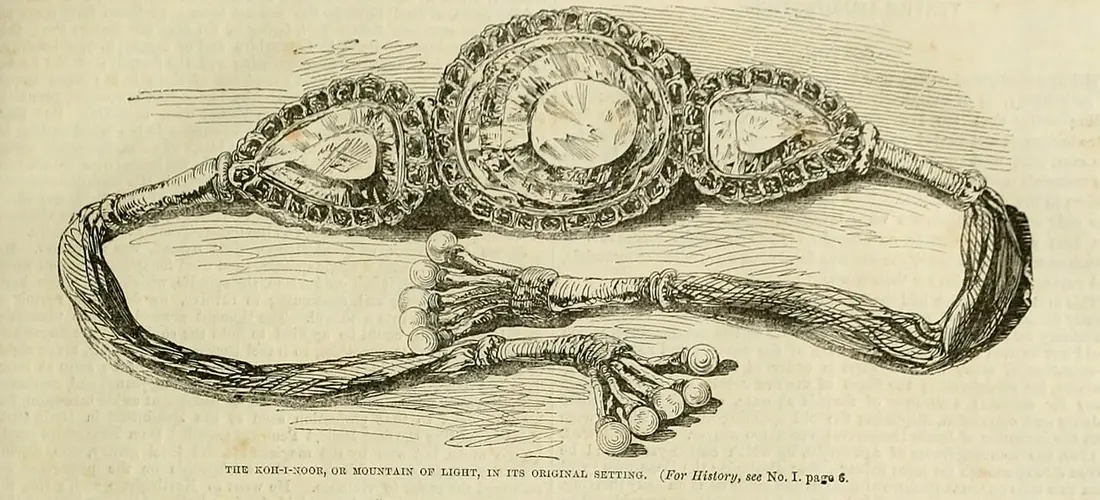
Its name means "Mountain of Light," and few objects have caused as much rivalry as the Koh-i-Noor. Once reputed to be the largest diamond on earth, it changed hands through conquest after conquest — Mughal emperors, a Persian invader, Afghan kings, Sikh maharajas — before ending up in the British Crown Jewels. Today four nations claim it, and the diamond has become a symbol of empire itself.
A diamond from the age of empires
The Koh-i-Noor almost certainly came from India’s Golconda region, the same diamond fields that produced the Hope. For centuries it adorned the thrones and turbans of Indian rulers — most spectacularly the Mughals’ jeweled Peacock Throne. Each new conqueror who seized northern India seized the diamond too.
Named by a conqueror
When the Persian ruler Nader Shah sacked Delhi in 1739, he carried off the Peacock Throne and the great diamond with it. Legend says that on first seeing the stone he exclaimed "Koh-i-Noor!" — Mountain of Light — giving it the name it still bears. From Persia it passed to Afghan rulers, and then to Maharaja Ranjit Singh, founder of the Sikh Empire, who prized it above all his treasures.
How Britain acquired it
After the British annexed the Punjab in 1849, the terms of the Treaty of Lahore required the young Maharaja Duleep Singh — then only a child — to hand the Koh-i-Noor to Queen Victoria. It was shipped to London and shown at the Great Exhibition of 1851, where crowds were underwhelmed: by European standards its old Mughal cut looked dull and lifeless.
To brighten it for Western eyes, the stone was recut from about 186 carats to roughly 105.6 — sacrificing nearly 40% of its weight for a flash of brilliance.
Recut for the Crown
Prince Albert ordered the diamond recut into a more brilliant oval. The work, done in 1852, dramatically increased its sparkle but shrank it significantly. It was then set into the crowns of queens consort — worn by Queen Alexandra, Queen Mary, and Queen Elizabeth The Queen Mother. By tradition it is worn only by women, owing to a long-standing superstition that the stone brings misfortune to men who wear it.
The diamond that four countries want back
India, Pakistan, Iran, and Afghanistan have all, at various points, demanded the Koh-i-Noor’s return, each citing its passage through their territory. The British government maintains it was acquired legally under treaty. The dispute has never been resolved, making the diamond one of the most politically charged objects in any museum.
- Name
- "Mountain of Light" (Persian)
- Weight
- ~105.6 carats (recut in 1852)
- Origin
- Golconda region, India
- Set in
- Crowns of British queens consort
- Home
- Tower of London, Crown Jewels
Wondering about an old heirloom stone? Diamond Identifier AI estimates a diamond’s qualities and value from a scan, and Ring Identifier reads a full ring or jeweled piece — a quick starting point before you visit a specialist.
The takeaway
The Koh-i-Noor’s real brilliance is its history. It is less a gemstone than a trophy passed between empires, recut to suit each new owner, and now frozen at the center of a debate about who the past belongs to. Whatever happens next, the Mountain of Light remains the most contested diamond in the world.
At a glance
| Fact | Detail |
|---|---|
| Current weight | 105.6 carats (after 1852 recut) |
| Previous weight | About 186 carats |
| Name | Persian for “Mountain of Light”, attributed to Nader Shah |
| Taken by Britain | 1849, Treaty of Lahore |
| Setting | Crown of Queen Elizabeth The Queen Mother (1937) |
| Displayed | Jewel House, Tower of London |
Frequently asked questions
Where is the Koh-i-Noor now?
In the Crown of Queen Elizabeth The Queen Mother, on display with the Crown Jewels in the Jewel House at the Tower of London.
Why was the Koh-i-Noor recut?
Its 1851 Great Exhibition display disappointed visitors who found it dull, so Prince Albert had it recut in 1852, reducing it from about 186 to 105.6 carats.
Which countries claim the Koh-i-Noor?
India, Pakistan, Afghanistan and Iran have all made claims at various times. The British government’s position is that it was acquired legally under the Treaty of Lahore.
Is the Koh-i-Noor the biggest diamond in the world?
No. It is far smaller than Cullinan I (about 530 ct); its fame comes from its history, not its size.
Sources and further reading
- Koh-i-Noor — Wikipedia
Links checked September 14, 2026.
Explore the apps
34 fast, fun, AI-powered apps with 1M+ on the App Store. Find your next favorite.
Browse all apps