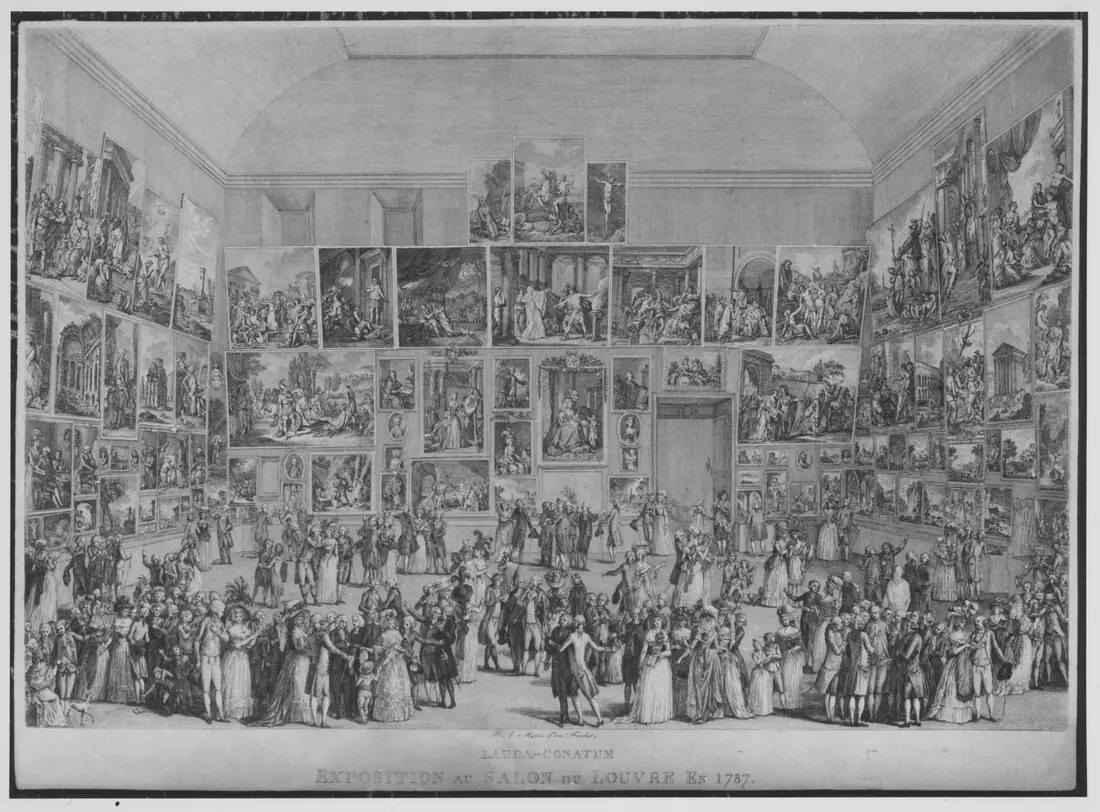
Almost nothing that goes wrong with art at home happens dramatically. Pictures are not usually dropped or slashed; they fade, cockle, bloom and crack over years, on a wall, in a room somebody was pleased with. Light damage in particular is cumulative and irreversible — the pigment you lose this summer does not come back in the winter — and it is also the easiest hazard in the house to control. A tape measure, a dimmer switch and a ten-dollar hygrometer cover most of the job.
Height first, because everyone gets it wrong
The convention in galleries and museums is to put the centre of the work at about 57 inches — 145 cm — from the floor, roughly average standing eye height. Some institutions use 60 inches. Either way the rule is the same and it is the centre that is fixed, not the top: hang a small drawing and a large canvas to the same centre line and the room acquires a horizon that makes a mixed wall look deliberate.
The awkward part is the arithmetic, because the nail does not go where the centre goes. Measure your hanger's drop — pull the wire or the D-ring taut towards the top of the frame and measure how far below the top edge it sits — and the rest falls out.
Two hooks are better than one, and the sum is the same: mark the hook height, then set both hooks on that line about a third of the width in from each side. In a room you mostly sit in — a dining room, a snug — drop the target to about 135 cm and the pictures will stop feeling like they are floating away.
Groups, and the gap above the sofa
- Treat a group as one object. Work out the outer rectangle of the whole arrangement and centre that at 145 cm. Lay it out on the floor first; it costs nothing and saves the wall.
- Keep the gaps tight and equal. Five to eight centimetres between frames reads as one composition. Twelve reads as indecision.
- Over furniture, leave 15 to 20 cm between the top of the sofa back and the bottom of the frame, and let the picture sit within the width of the furniture rather than overhanging it.
- Above a console or a mantel the picture is being viewed from further back, so the centre rule bends — align it to the object below and trust your eye.
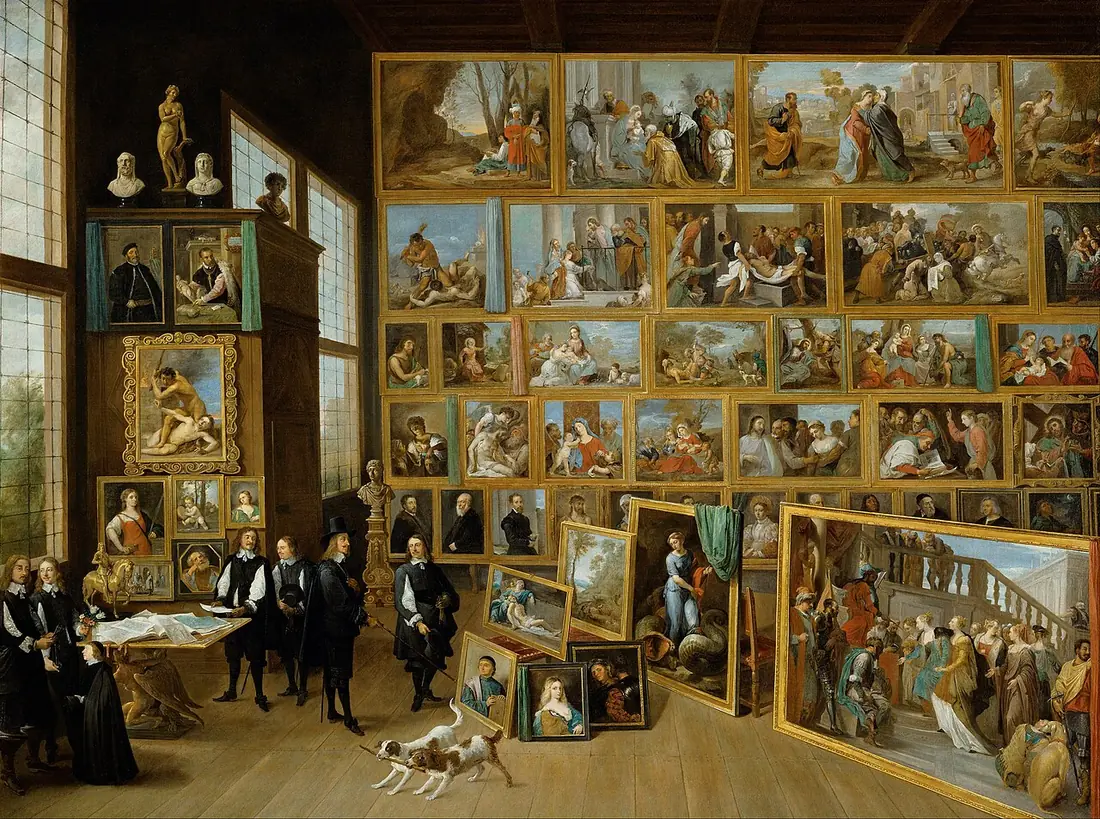
Light is a budget, and you only get to spend it once
Conservation treats light as a quantity rather than a setting. What matters is illuminance multiplied by time — lux-hours — so a work under 50 lux around the clock takes exactly the same damage as one under 200 lux for six hours. Museums split collections into three bands and cap the brightness accordingly: about 50 lux for anything on paper or textile, 150 to 200 lux for oils, wood and leather, and around 300 lux for stone, ceramic and metal, which barely cares.
Illuminance bands follow standard museum practice as summarised by conservation lighting guidance; the cumulative-damage arithmetic is the lux-hours model used by the American Museum of Natural History, and the annual ceilings are the commonly cited figures of roughly 50,000 lux-hours for highly sensitive material and around 650,000 for oil paintings. They are planning numbers, not a warranty — a phone light-meter app will get you close enough to know which band you are in.
Nothing you can do to a painting later will give back the colour that light has taken. Every other kind of damage has a conservator; fading has only prevention.
Ultraviolet, and the fittings that produce it
UV does disproportionate damage for the light it delivers, which is why conservators filter it rather than dim it. The traditional threshold is 75 microwatts of UV per lumen, above which a filter is expected; the modern answer is to get as close to zero as you can.
- Daylight is the worst offender by a wide margin. Never hang anything you care about where a beam of sun crosses it, at any time of year. Track the light for a full day before you commit to a wall.
- Halogen and incandescent emit UV and a lot of heat. Charming light, poor conservation.
- Quality LED produces essentially no UV, dims cleanly and runs cool. It is the obvious choice; look for a high colour-rendering index so the pigments read honestly.
- UV-filtering glazing — acrylic or laminated glass — removes the great majority of UV and is the single best upgrade for anything on paper. Museum-grade anti-reflective versions cost more and let you actually see the work.
- Window film and blinds protect everything in the room at once, which is usually cheaper than glazing each frame.
The 30-degree rule for picture lights
Aim a light at roughly 30° from vertical, measured at the centre of the picture. Shallower and the beam bounces straight back into your eyes as glare; steeper and it rakes the surface, throwing the texture of the canvas and every ripple in the varnish into relief. Add about five degrees for a deep frame so the rabbet does not cast a shadow across the top of the image.
Put the fitting on a dimmer, set it to the lowest level that lets you actually see the picture, and switch it off when the room is empty. A lamp on a timer is a conservation device disguised as a convenience.
Temperature and humidity: stability beats perfection
Canvas, panel and paper all take up moisture and move; paint and ground do not move at the same rate. That mismatch is what cracks, cups and flakes a picture, and it is driven by change rather than by any particular value. Aim for 40–60% relative humidity — 50% is the usual target — and 18–24 °C, and care far more about holding it steady than about hitting it exactly. A stable 45% is kinder than a room that swings between 35% and 65% every week.
Which makes the choice of wall a conservation decision. Tap through the usual suspects.
—
—
The hardware that is actually holding it up
- Two hooks, not one. The picture stays level, the load is halved, and it survives a slammed door. This is the cheapest improvement on this page.
- D-rings screwed into the frame's sides, about a third of the way down, beat a single sawtooth hanger for anything heavier than a small photograph. Screws into the frame stiles, never into the mitred corners.
- Braided steel wire, not nylon or twine. Nylon creeps under load and lets the picture sag over years; twine simply fails one day. Replace any wire you did not fit yourself, and check the fittings annually.
- Anchor for several times the weight. Into a stud if you can find one; otherwise a proper cavity anchor rated well above the picture, not a masonry nail and hope.
- Never hang from the stretcher bars of a canvas, and never screw anything into the back of a panel. The frame carries the load.
- Cork or felt bumpers at the bottom two corners hold the picture a few millimetres off the wall, let air move behind it, and stop it drifting crooked.
Glazing, backing and room to breathe
Anything on paper should be glazed, and the glazing must never touch the surface — a window mount or slim spacers hold it clear, because condensation against glass is how a print gets a mould bloom or sticks to it permanently. Use conservation-grade board on all four sides, not the cheap brown card that yellows and burns a line into the sheet within a decade.
Oils on canvas are usually left unglazed, and gain more from a rigid backing board fitted to the reverse: it buffers knocks from behind, keeps dust and insects out of the stretcher, and evens out the humidity the canvas sees. If a picture already shows craquelure, cupping or old restoration, read how to read a painting's condition before you change anything, and keep the cleaning to a dry sable brush — the limits are set out in how to clean an oil painting.
Not sure what you have on the wall? Art Scan: Painting Identifier suggests a likely artist, period and medium from a photograph, and Art Identifier Museum Guide puts a work in its art-historical context. Knowing the medium is what tells you which light band it belongs in — and if the answer is “watercolour”, the answer to “how bright?” is 50 lux.
- Centre height
- 145 cm / 57 in, measured to the middle
- Hook height
- Centre + half the height − the hanger drop
- Paper, textiles
- 50 lux, and glaze it
- Oil on canvas
- 150–200 lux, usually unglazed
- Light damage
- Cumulative, irreversible, lux × hours
- UV
- Filter below 75 µW per lumen, or use LED
- Humidity
- 40–60% RH, stability over accuracy
- Worst walls
- Over a fire, in sun, bathrooms, exterior walls
The takeaway
Hang to the centre line, not the top edge. Choose the wall by tracking the sun across it for a day and by what is on the other side of it, then light it with dimmable LED at the lowest level you can live with and switch it off when you leave the room. Glaze anything on paper with UV-filtering acrylic and keep the glass off the surface. None of this is expensive, and all of it is the difference between a painting your grandchildren argue over and one they describe as having gone rather pale.
At a glance
| Guideline | Value |
|---|---|
| Picture center height | 145 cm / 57 in (135 cm in seated rooms) |
| Gap above furniture | 15–20 cm |
| Works on paper, textiles, photographs | About 50 lux, glazed |
| Oil or acrylic on canvas, panel | 150–200 lux |
| Stone, ceramic, metal | About 300 lux |
| Picture-light angle | About 30° from vertical |
| Relative humidity | 40–60% RH, held steady; 18–24 °C |
Frequently asked questions
How high should a painting be hung?
Galleries typically hang the center of a picture about 145 cm (57 in) from the floor. Treat a group of pictures as one rectangle and center that.
Is sunlight bad for paintings?
Yes. Light damage is cumulative and irreversible, and sunlight is rich in ultraviolet. Works on paper and watercolors fade fastest.
Are LED lights safe for art?
Good-quality LEDs emit almost no ultraviolet or heat, making them the preferred choice, provided brightness is kept to the right lux level.
What humidity is best for paintings?
Around 40–60% relative humidity, with stability mattering more than the exact number. Rapid swings cause canvas and panels to move and paint to crack.
Sources and further reading
- Caring for Your Treasures — American Institute for Conservation
- Art conservation and restoration — Wikipedia
Links checked September 14, 2026.
Explore the apps
34 fast, fun, AI-powered apps with 1M+ on the App Store. Find your next favorite.
Browse all apps