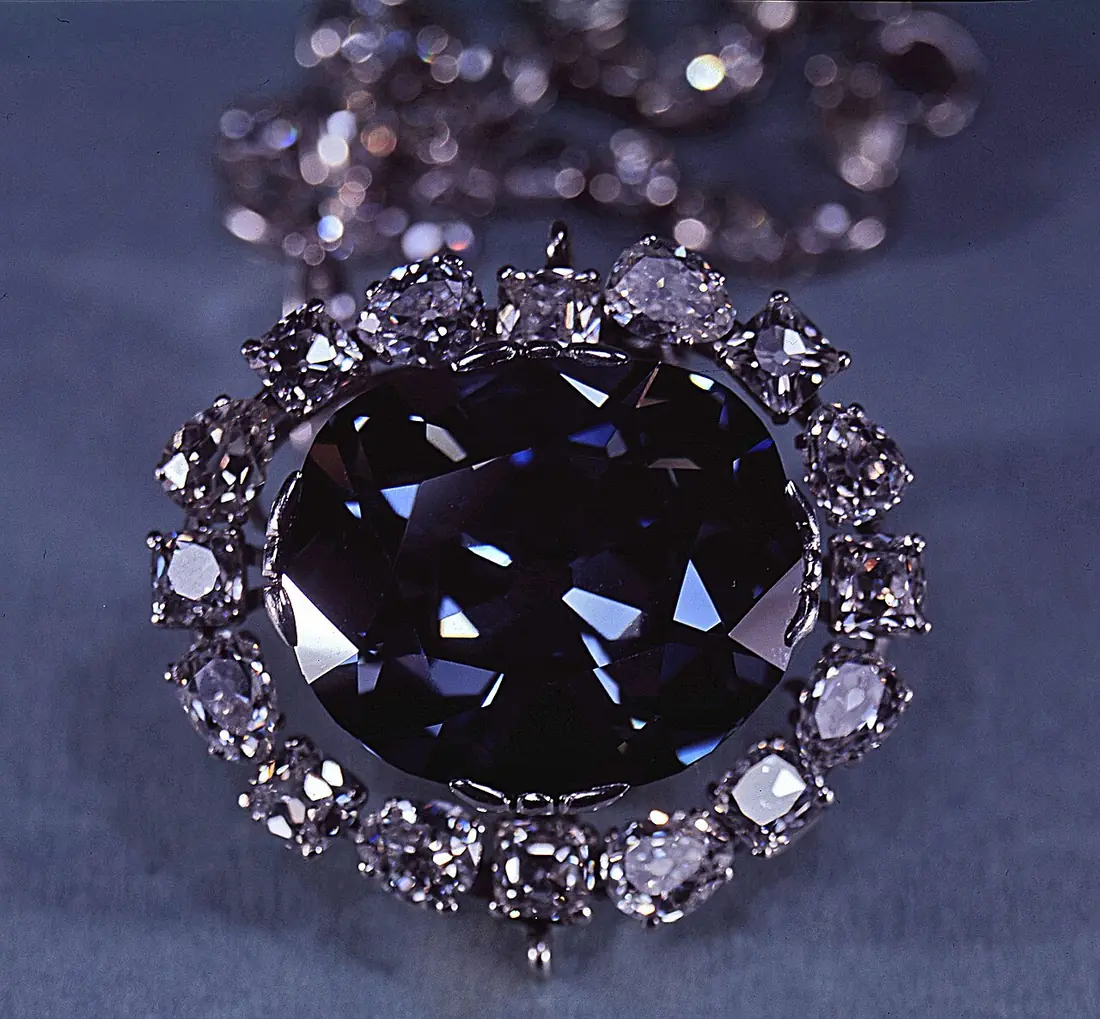
No gemstone on earth is wrapped in more legend than the Hope Diamond. It is a deep, grayish-blue stone of 45.52 carats — and when you switch off the lights after exposing it to ultraviolet, it glows an eerie red, as if lit from inside. Add a trail of beheaded royals, daring thefts, and a "curse" that supposedly doomed its owners, and you have the most famous diamond in the world. Here’s what’s true, what’s myth, and why it’s considered priceless.
From an Indian mine to a French king
The story begins in the legendary Golconda mines of India, where the stone was found as a large, rough blue crystal. In the 1660s the French gem merchant Jean-Baptiste Tavernier acquired it and sold it to King Louis XIV. The Sun King had it recut into a stone known as the "French Blue," set in gold and worn on a ribbon. For more than a century it was a crown jewel of France.
Stolen in the Revolution, reborn smaller
During the chaos of the French Revolution in 1792, the royal treasury was looted and the French Blue vanished. It resurfaced decades later in London — recut and smaller, almost certainly to disguise its origins. By 1839 it appeared in the gem catalog of the wealthy banker Henry Philip Hope, whose family name it carries to this day.
Why it’s blue — and why it glows
The Hope’s color comes from traces of boron trapped in its carbon lattice, which absorb red and yellow light and leave that famous deep blue. The same chemistry produces its strangest trick: after ultraviolet light, the diamond phosphoresces a fiery red-orange for several seconds. To gemologists this glow is a kind of fingerprint, helping confirm the stone’s identity across centuries.
The "curse" was largely a marketing tale, amplified by jewelers and newspapers. The science — boron, phosphorescence, a Golconda origin — is far more remarkable than the superstition.
The "curse" and the American heiress
The jeweler Pierre Cartier helped popularize the idea of a deadly curse, which made the diamond irresistible to the Washington socialite Evalyn Walsh McLean, who bought it in 1911 and wore it constantly. Tales of misfortune followed her family — but historians note the curse stories were stitched together to sell the stone, not recorded fact.
A plain box to the Smithsonian
The jeweler Harry Winston bought the diamond in 1949 and, in 1958, donated it to the Smithsonian Institution. Famously, he mailed it to Washington in a simple brown paper package by registered post. Today it sits in the National Museum of Natural History, one of the most visited museum objects on the planet.
- Weight
- 45.52 carats
- Color
- Fancy deep grayish-blue (from boron)
- Origin
- Golconda mines, India
- Quirk
- Phosphoresces red under UV light
- Home
- Smithsonian, Washington, D.C.
Curious what a blue stone of your own might be? Diamond Identifier AI scans a diamond to estimate its color, qualities, and value, and Ring Identifier does the same for a full piece of jewelry. They won’t find a Hope, but they’re a fast first read before a certified appraisal.
The takeaway
The Hope Diamond endures because it sits at the crossroads of science and story: a boron-blue Golconda gem that literally glows, carried through revolutions and reinventions, and dressed in a curse that sold newspapers. Strip away the myth and what remains is rarer still — one of the most studied, storied, and beautiful blue diamonds ever found.
At a glance
| Fact | Detail |
|---|---|
| Weight | 45.52 carats |
| Color | Fancy dark grayish-blue (boron) |
| Origin | Golconda diamond fields, India |
| Former identity | The French Blue of Louis XIV |
| Current home | Smithsonian National Museum of Natural History |
| Donated | 1958, by Harry Winston, sent by registered mail |
Frequently asked questions
How much is the Hope Diamond worth?
It has no market price because it will not be sold; estimates commonly cited run to hundreds of millions of dollars. The Smithsonian insures it but does not publish a value.
Why is the Hope Diamond blue?
Trace amounts of boron in the crystal absorb red light, giving a blue color. The same impurity makes it phosphoresce red-orange after exposure to UV light.
Is the Hope Diamond cursed?
The “curse” was largely promoted in the early 20th century, including by the jeweler Pierre Cartier while selling it to Evalyn Walsh McLean. There is no evidence for it.
Where can I see the Hope Diamond?
In the Harry Winston Gallery of the Smithsonian National Museum of Natural History in Washington, D.C.
Sources and further reading
- Hope Diamond — Wikipedia
- Diamond: gemstone information — GIA
Links checked September 14, 2026.
Explore the apps
34 fast, fun, AI-powered apps with 1M+ on the App Store. Find your next favorite.
Browse all apps