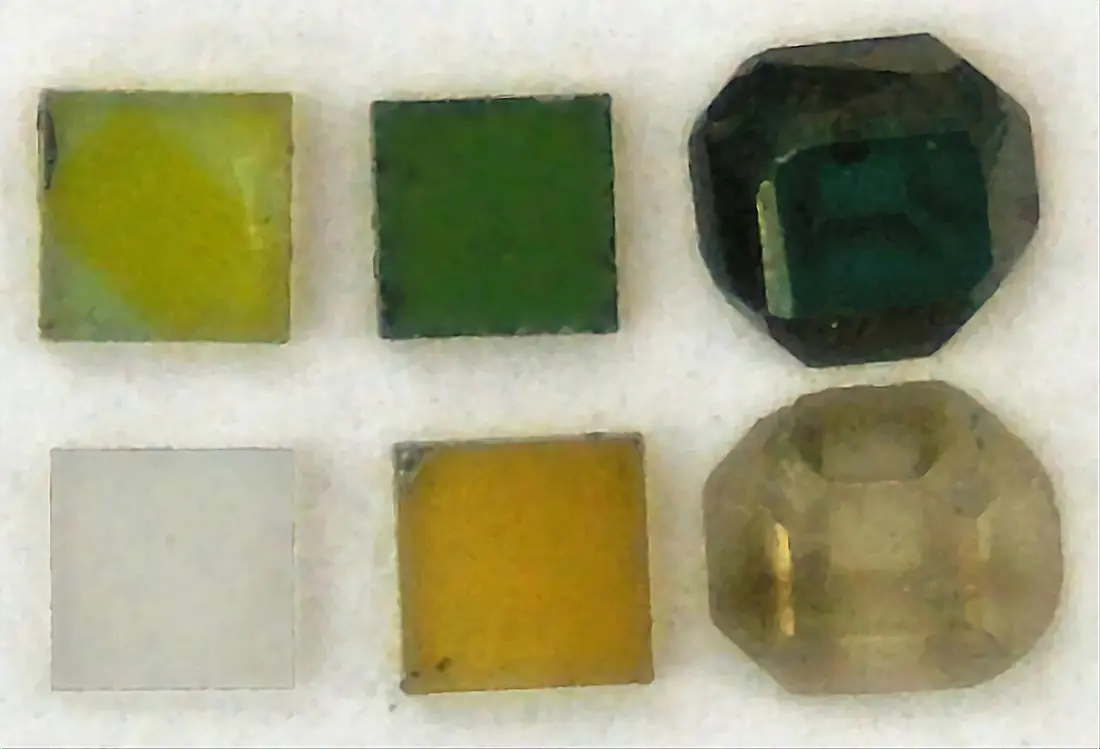
A diamond can be made to look better than it was born. Cracks can be filled with glass so they vanish, dark inclusions can be burned out with a laser, brownish stones can be pressed back to colourless, and colourless stones can be irradiated into vivid blue or green. None of this is illegal and none of it is necessarily wrong — treated stones are a legitimate part of the market at the right price. The problem is buying one at an untreated price, which happens constantly, because the tells are small and the paperwork is quietly different.
The five treatments you’ll actually meet
Tap one. Each card tells you what it does to the stone, how it is detected, whether it survives normal life, and what it means for the price.
Fracture filling
Not permanentA molten lead-based glass is forced into surface-reaching cracks. The glass has a refractive index close to diamond, so a white feather that used to catch the eye becomes nearly invisible and the stone reads one or two clarity grades higher than it is.
- How it’s detected
- The flash effect: a sudden flare of orange, pink, blue or green from inside a fracture as you rock the stone under a loupe or microscope.
- Does it survive?
- Not reliably. The filler can be damaged by a jeweler’s torch during repairs, by ultrasonic cleaning, and even by strong heat — leaving the crack visible again.
- What it does to price
- Large discount. A filled stone should be priced on its untreated clarity, which is usually several grades lower.
The flash effect, and how to look for it
This is the single most useful skill in the article. Filled fractures act like a thin film: as you tilt the stone, the filled plane flares a colour that no natural inclusion produces — classically a pink or orange flash in dark-field light and a complementary green in bright field, which GIA describes as diagnostic of glass-filled fractures. Rock the stone slowly, table-up, under a single light. Naturals go dark and light; a filled feather throws colour.
Simulation, not a photograph: as a filled stone rocks under the light, the treated plane flares colour and then disappears. In the hand it is a quick, unmistakable flicker — and it is why gemologists rock every stone they look at.
What the paperwork tells you
Labs draw a firm line between treatments that last and treatments that don’t. GIA issues reports for laser-drilled and HPHT-processed diamonds with the treatment disclosed prominently, and laser-inscribes the girdle of stones it identifies as HPHT-processed. It does not issue grading reports at all for unstable treatments such as fracture filling or coating. That gives you a shortcut: if a stone is “clarity enhanced” and the seller cannot produce a normal grading report from a major lab, you already know why.
Report red flags
- “Clarity enhanced”, “Yehuda”, “Koss”, “Genesis II” — trade names for filling. Treat as filled.
- A grading report with no clarity grade, or an “identification report” instead of a grading report.
- Comments mentioning laser drill holes, “internal graining is present”, “HPHT processed”, or “treated colour”.
- A girdle inscription you can’t match to the report number — check it under a loupe, every time.
- “No lab report because it’s a family stone.” Reports cost a small fraction of a serious diamond’s value.
Treated, synthetic, or simulant — three different things
- Treated: a real, mined diamond that has been altered. Still a natural diamond, just improved after the fact.
- Lab-grown: real diamond, grown rather than mined. Not a treatment and not a fake — a different origin, at a different price. See lab-grown vs natural.
- Simulant: not diamond at all — cubic zirconia, moissanite, white sapphire. A different material entirely, which the home tests can often catch.
All three can be described by a careless seller as “a real diamond”, and only one of those statements is straightforwardly false. Ask the question precisely: is it mined, is it treated, and is that on a report?
There is nothing wrong with buying a treated diamond. There is a great deal wrong with buying one without knowing — because the discount you should have received is exactly the money you lose when you come to sell.
Buying safely, in five moves
- Ask in writing. “Has this stone been treated or enhanced in any way, including filling, drilling, HPHT or irradiation?” A written answer changes your options if it turns out to be wrong.
- Insist on a major-lab report for anything meaningful, and verify the number on the lab’s own site rather than a printout.
- Rock the stone under a light and look for flashes of colour and for tiny straight tubes running in from the surface.
- Be suspicious of a bargain that is too clean. A visibly eye-clean stone priced like an I1 usually is an I1, with help.
- Tell your jeweler before any repair. Heat and ultrasonic cleaning can undo a filling and damage some treated colours — a treated stone needs to come out of the setting first.
Working out what you have before you pay for a report? Diamond Identifier AI gives a quick read on a stone’s likely characteristics and value, and Ring Identifier does the same for a whole piece. Neither can certify a treatment — that takes a lab with spectroscopy — but they are a sensible first step before you decide what is worth submitting.
- Never permanent
- Fracture filling, coating and painting
- Permanent
- Laser drilling, HPHT colour, irradiation colour
- Biggest tell
- A flash of orange, pink or green inside a crack
- Paperwork tell
- No clarity grade, or no grading report at all
- Care warning
- No ultrasonic cleaning, no torch, no steam
- Fair price
- Based on the stone’s untreated grade
The takeaway
Every treatment leaves evidence, in the stone or in the paperwork. Learn the flash effect, learn to spot a drill tube, and learn that a missing clarity grade is a sentence in itself. Then decide with open eyes: a filled stone at a filled-stone price can be a lovely ring, while the same stone at a natural price is simply an expensive lesson about how much of a diamond’s value is information rather than carbon.
At a glance
| Treatment | What it changes | How it’s found | Durability |
|---|---|---|---|
| Laser drilling | Removes dark inclusions | Tiny tunnels under magnification | Permanent |
| Fracture filling | Hides feathers | Flash effect (blue/orange) when tilted | Can be damaged by heat or repairs |
| HPHT | Removes brown or creates color | Lab instruments | Permanent |
| Irradiation (+ heat) | Adds green, blue, yellow, pink | Lab spectroscopy | Stable in normal wear |
| Coating | Masks tint or adds color | Magnification; lab | Wears off |
Frequently asked questions
Is a treated diamond a real diamond?
Yes, it is still diamond. But treatment must be disclosed and lowers value, often substantially compared with an untreated stone of similar appearance.
What is the flash effect?
A telltale flash of color — often blue or purple in one position and orange or yellow in another — seen when tilting a fracture-filled diamond. It comes from the glass-like filler.
Will GIA grade a clarity-enhanced diamond?
GIA identifies fracture-filled diamonds but does not assign grades to them. Laser-drilled and HPHT-treated diamonds can be graded, with the treatment noted on the report.
Do jewelers have to tell me a diamond is treated?
In the United States, the FTC Jewelry Guides say sellers should disclose treatments that are not permanent, require special care, or significantly affect value.
Sources and further reading
- 16 CFR Part 23 — Guides for the Jewelry, Precious Metals, and Pewter Industries — U.S. Electronic Code of Federal Regulations
- Diamond enhancement — Wikipedia
- Diamond Description — GIA
Links checked September 14, 2026.
Explore the apps
Fast, fun, AI-powered apps with 1M+ on the App Store. Find your next favorite.
Browse all apps