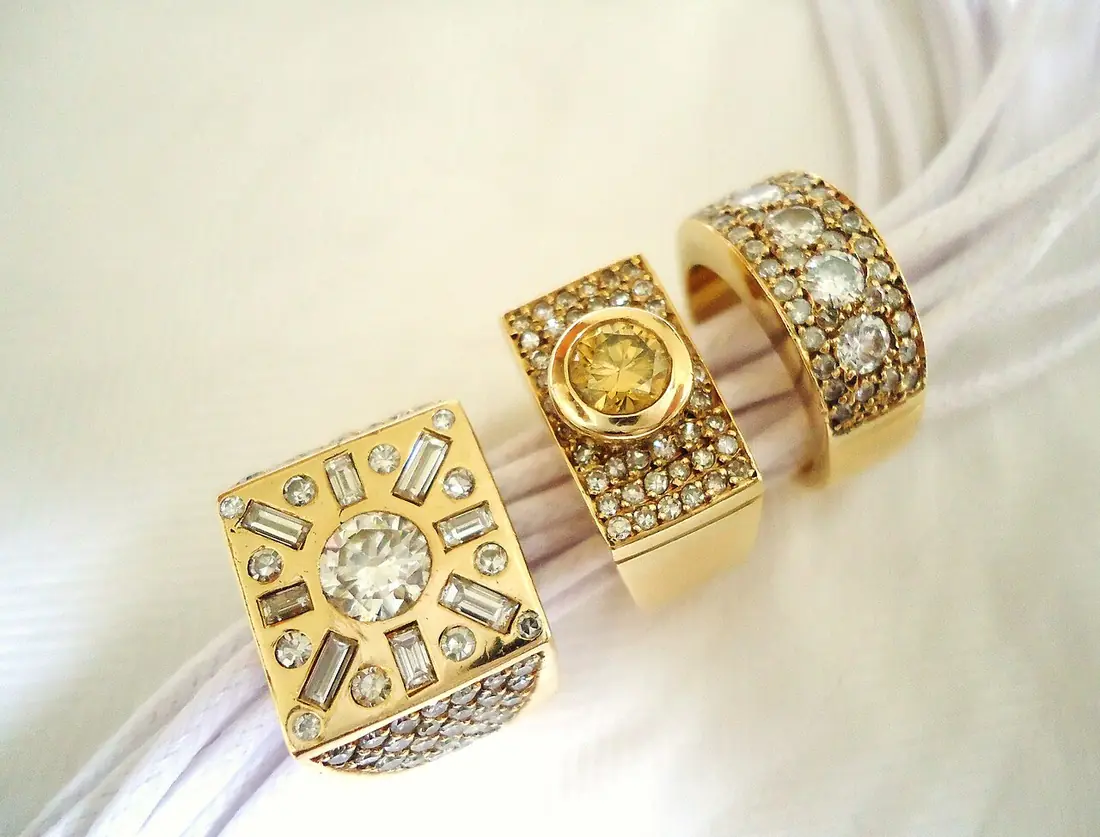
“What’s my ring worth?” is four questions wearing one coat. The insurer answers it with the price of buying a new one at full retail. The refiner answers it with the weight of metal after the stones are pried out. A private buyer answers with what they’d risk on a stranger’s ring, and a pawn shop answers with what it can flip by Friday. All four numbers can be honest at the same time, and the gap between the highest and the lowest is routinely four or five to one. Knowing which number you need is most of the work.
The four numbers, side by side
Put in what the ring cost new — or what a jeweler’s appraisal says — and watch it fall down the ladder. These proportions are the ranges the trade itself publishes; individual pieces move around a lot, and branded or collectible rings break the pattern in the owner’s favour.
A jeweler’s own published ladder puts wholesale near half of retail, fair market value around 30–40%, and immediate liquidation offers near a fifth — with the loud caveat that brand, stone quality, condition and the gold price all move these numbers. Beneath every line sits a hard floor: the melt value of the metal.
Number one: melt value, the floor under everything
Melt is the least romantic and most reliable number, because it’s arithmetic. Weigh the ring in grams, multiply by the purity fraction, multiply by today’s metal price. A 4-gram 14K band contains 4 × 0.585 = 2.34 grams of gold, and gold traded around $4,300 an ounce as this was written — about $138 a gram. That’s roughly $320 of gold in a plain band that probably cost $600 new.
Two corrections that matter. First, the scale weighs stones too — subtract about 0.2 g per carat before you trust the number. Second, nobody pays spot: specialist buyers and refiners commonly land in the 70–90% range, while pawn shops and cash-for-gold counters often sit well below that. Prices above are examples from mid-2026 — check the day’s spot before you negotiate.
Number two: what the stones really add
Here is where expectations break. A centre stone with a grading report is a tradable asset. The sparkle around it mostly isn’t.
- Melee is nearly free. GIA defines melee as stones under about 0.2 carats; they’re bought and sold in parcels by the hundred, not individually. A halo and a pavé band can add a great deal of visual size and very little resale value.
- Certification changes the conversation. A GIA or AGS report on the centre stone removes the buyer’s guesswork, and buyers pay for certainty. No paper means the next buyer assumes the worst grade in the plausible range.
- Lab-grown stones resell poorly. They are real diamonds, but production costs have fallen fast and the secondary market prices them accordingly — typically a small fraction of what was paid.
- Coloured stones are their own market. Untreated ruby, sapphire and emerald of good origin can outperform a diamond of the same size; treated or synthetic ones can be worth almost nothing. Origin reports matter more here than anywhere else.
- Damage is disproportionate. A chipped girdle or an abraded culet means recutting, which means weight loss, which means a new and smaller stone. Buyers discount hard for it.
Where the retail price actually went
The reason resale feels like a betrayal is that a big share of the original ticket never had anything to do with the ring. Rough shape of a typical mass-market diamond ring, for illustration rather than as a survey:
- Centre stone the only part with a real resale market
- Metal & melee the melt floor, plus accent stones
- Making casting, setting, polishing, finishing
- The shop rent, staff, stock, marketing, margin
You aren’t reselling the shop. That’s why a wholesale or trade valuation lands near half of retail before anyone has even looked at the stone.
Number three: insurance replacement value
An insurance appraisal answers a narrow question: what would it cost to walk into a retail store and buy this ring again, new, today? It is deliberately a retail number, which is why it can run two to three times a realistic cash offer. That’s not fraud and it isn’t a mistake — it’s the wrong tool for selling, and the right tool for being made whole after a loss.
- Schedule the piece. Standard home contents cover usually caps jewellery at a low per-item figure. A scheduled rider or a specialist jewellery policy covers the appraised value, including loss and often damage.
- Keep the evidence together. The grading report, the original receipt, photographs of the marks inside the band, and the appraisal. Reconstructing a ring from memory is how claims get reduced.
- Re-appraise periodically. Appraisals are priced in a moment. When metal prices climb, an old valuation quietly underinsures you; every few years is a sensible cadence.
- Ask for the reasoning. A good appraisal shows the measurements, grades, weights and comparable prices behind the total. A one-line number on letterhead is decoration.
An appraisal is not an offer. It’s an opinion written for a specific purpose — replacement, division, donation, or sale — and the purpose sets the number long before the ring does.
Number four: what a buyer will hand you
Every channel trades money for speed. Pick your position on that curve honestly.
Relative, not absolute — the bars compare typical outcomes for the same ring, not guaranteed percentages. One rule holds everywhere: get at least three offers, and never let anyone take the ring out of sight to “weigh it”.
Get a number you can act on
- Read the band first. The stamps give you metal and purity, and you cannot compute melt without them. If there are no marks, any jeweler with an XRF gun will read the alloy in seconds.
- Weigh it properly. A 0.01 g kitchen scale is enough. Note the gross weight, then estimate stone weight separately.
- Find the paperwork. A grading report number can usually be verified on the lab’s own site, which instantly settles the biggest variable in the whole calculation.
- Then pay for one hour of expertise. An independent appraiser who doesn’t want to buy your ring has no reason to shade the number. Ask for the intended use — replacement or fair market — in writing, because it determines everything.
Want a rough read before you spend anything? Ring Identifier scans a whole piece — band, setting and stones — for an estimate of what it is and roughly what it’s worth, and Diamond Identifier AI concentrates on the centre stone. Use them to decide whether a ring is a $200 conversation or a $10,000 one; use a certified appraiser to decide what to put on a policy or a price tag.
- Melt value
- grams × purity × today’s price per gram
- Typical payout
- 70–90% of melt from specialists; less at kiosks
- Insurance value
- Full retail replacement — never a selling price
- Fair market
- Roughly a third of retail for unbranded pieces
- Adds most value
- A certified centre stone, a real brand, condition
- Adds least
- Melee, halos, plating, the original receipt
The takeaway
Start with the floor and work up. Compute melt, because it’s arithmetic and nobody can argue with it. Add the centre stone only to the extent you can prove what it is. Treat the insurance figure as a replacement cost and never as a price. Then decide what you’re optimising for — the highest number takes months of private selling, and the fastest number is metal weight in cash today. Rings lose the shop’s share of their price the moment they leave the shop; everything else you can actually measure. When you’re ready, how to sell a ring compares who pays what.
At a glance
| Value | What it is | Who uses it |
|---|---|---|
| Melt value | Metal weight × purity × spot price | Refiners, gold buyers |
| Cash offer | Typically 70–90% of melt from specialists; less at kiosks and pawn | Buyers paying today |
| Fair market value | Price between willing buyer and seller; often ~⅓ of retail for unbranded | Resale, estates |
| Insurance replacement | Cost to buy a similar new ring at retail | Insurers, appraisals |
Frequently asked questions
How do I calculate the gold value of my ring?
Weigh it in grams, multiply by purity (0.417 for 10K, 0.585 for 14K, 0.75 for 18K), then by today’s gold price per gram. Subtract stones’ weight first if you can.
Why is my appraisal so much higher than what jewelers offer?
Insurance appraisals state retail replacement cost. A buyer pays wholesale or less because they need to resell with a margin.
Are small diamonds in my ring worth much?
Usually little on resale. Melee — tiny diamonds under about 0.2 carat — is traded in parcels, so accent stones rarely add much to a cash offer.
Where should I sell a diamond ring?
For a certified stone or a signed designer piece, compare offers from a specialist diamond buyer, an auction house and a consignment dealer. For a plain gold ring, a refiner or specialist gold buyer usually pays closest to melt.
Sources and further reading
- World Gold Council — World Gold Council
- 16 CFR Part 23 — Guides for the Jewelry, Precious Metals, and Pewter Industries — U.S. Electronic Code of Federal Regulations
- Diamond Description — GIA
Links checked September 14, 2026.
Explore the apps
34 fast, fun, AI-powered apps with 1M+ on the App Store. Find your next favorite.
Browse all apps