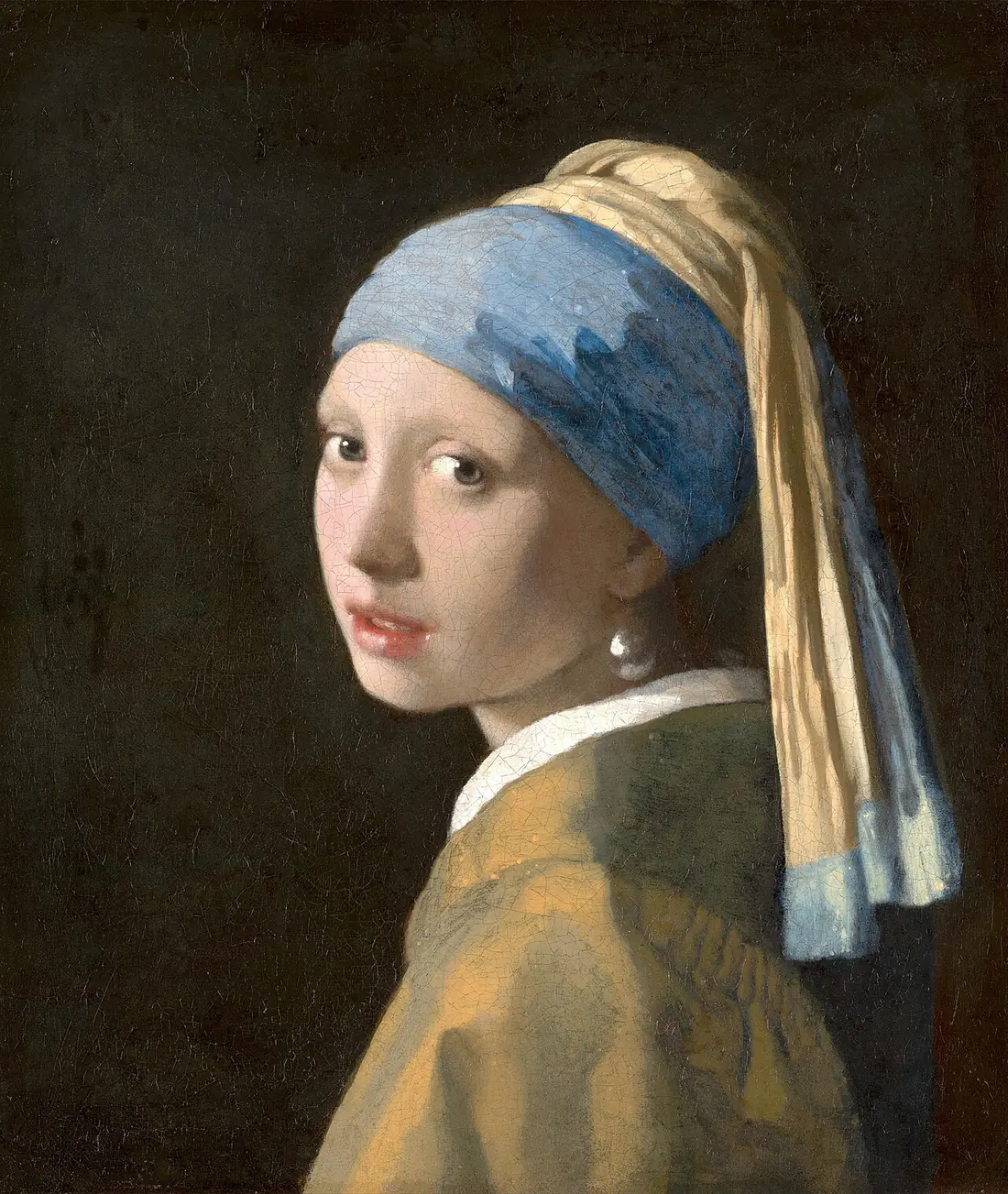
She turns toward us out of total darkness, lips just parted, a single pearl glowing at her ear. Johannes Vermeer’s Girl with a Pearl Earring is often called the "Mona Lisa of the North" — yet it isn’t a portrait at all, and that famous pearl may not be a pearl. Painted around 1665 in the Dutch Golden Age, it remains one of art’s most quietly captivating mysteries.
Not a portrait — a "tronie"
Despite how personal it feels, the painting isn’t a likeness of a specific person. It’s a tronie — a popular Dutch genre showing an anonymous figure as a study of a type, mood, or exotic costume rather than a commissioned portrait. The girl’s blue-and-gold turban and her timeless, placeless setting are clues: Vermeer was painting an idea, not a named sitter.
The light is the subject
Vermeer was a master of light, and here it does all the work. A soft glow falls across the girl’s face from the left, catching the moist highlight on her lower lip and the wet gleam of her eyes. The background is a flat, deep darkness — recent study suggests it was once a subtle green curtain that has darkened with age — which makes the figure seem to float forward into the light.
The pearl is painted with almost nothing — two quick strokes of white. Step back and your eye assembles them into a glowing jewel.
The pearl that may not be a pearl
Look closely and the "pearl" is barely there: a soft blob of light and a sharp dab of white, with no defined edge or hook. Some experts argue it’s far too large to be a real pearl and was more likely polished glass or tin finished to imitate one. Vermeer’s genius was suggesting a luminous, rounded jewel with the fewest possible marks — a tiny lesson in how the eye fills in what the brush only hints at.
Rediscovered and reimagined
Vermeer was nearly forgotten for two centuries after his death. This painting resurfaced in the late 1800s and was bought cheaply before its importance was understood. Its modern fame exploded with Tracy Chevalier’s 1999 novel and the 2003 film it inspired, both imagining a story for the unknown girl. It now hangs in the Mauritshuis museum in The Hague.
- Artist
- Johannes Vermeer
- Date
- c. 1665
- Type
- A "tronie," not a portrait
- Medium
- Oil on canvas
- Home
- Mauritshuis, The Hague
Came across a painting you can’t identify? Art & Painting Identifier suggests the artist, title, and style from a single photo, and Art Identifier Museum Guide turns a gallery visit into a guided tour.
The takeaway
Girl with a Pearl Earring proves that mystery can be more powerful than detail. With an anonymous sitter, a few strokes of light, and a pearl that may be an illusion, Vermeer created a face that has held the world’s gaze for over 350 years.
At a glance
| Fact | Detail |
|---|---|
| Artist | Johannes Vermeer |
| Date | c. 1665 |
| Medium | Oil on canvas |
| Size | About 44.5 × 39 cm |
| Type | Tronie (character study), not a commissioned portrait |
| Location | Mauritshuis, The Hague |
Frequently asked questions
Who is the girl in Girl with a Pearl Earring?
No one knows. There is no record of a sitter, and the work is considered a tronie. Tracy Chevalier’s 1999 novel invented a story, but it is fiction.
Is the pearl real?
Probably not a real pearl: it is too large, and its painted reflections suggest glass or tin. It has no visible hook either.
Where can I see Girl with a Pearl Earring?
At the Mauritshuis in The Hague, the Netherlands. The museum rarely lends it.
What did the Girl with a Pearl Earring research project find?
The Mauritshuis’s 2018 “Girl in the Spotlight” study found tiny eyelashes, a green curtain behind the girl that has faded, and pigments sourced internationally, including ultramarine from lapis lazuli.
Sources and further reading
- Girl with a Pearl Earring — Mauritshuis, The Hague
- Girl with a Pearl Earring — Wikipedia
Links checked September 14, 2026.
Explore the apps
34 fast, fun, AI-powered apps with 1M+ on the App Store. Find your next favorite.
Browse all apps