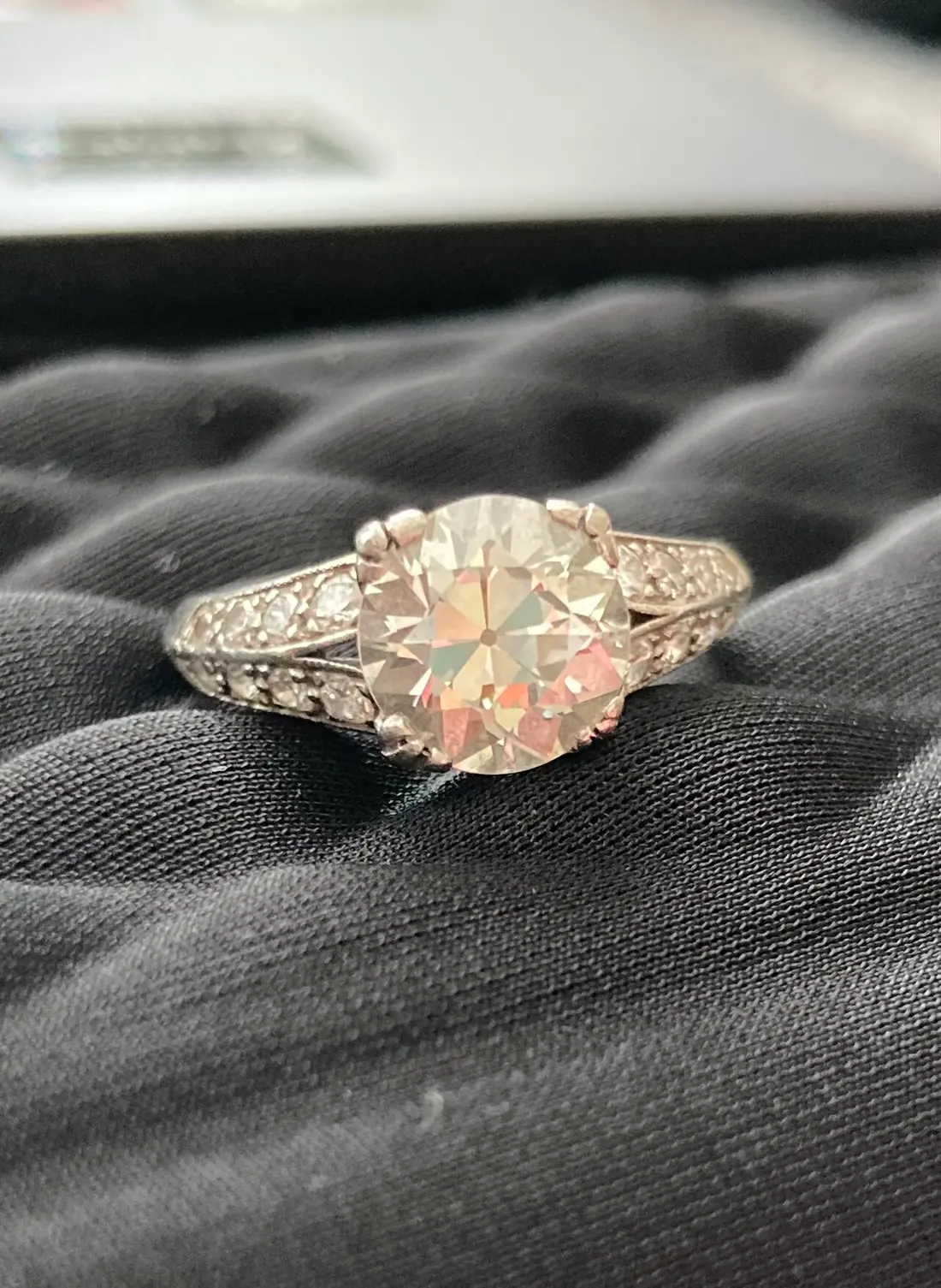
Put a Victorian diamond next to a modern one under a showroom spotlight and the old stone loses. It looks softer, hazier, almost sleepy. Move both to a candlelit table and the result flips completely: the antique glows with big, slow flashes while the modern stone crackles into tiny white pinpricks. That isn’t an accident of quality. Antique cuts were designed by hand, by eye, for the light people actually lived in — and once you know what to look for, you can spot one across a room.
Why old cuts look different
Before electric light, a diamond’s job was to catch a flickering flame. Cutters shaped stones with large facets and open culets — the flat facet at the very bottom point — which produce broad, rolling flashes of light rather than rapid sparkle. They also cut by hand, following the rough crystal to save weight instead of chasing ideal proportions. The result is a stone with character: slightly uneven, warmer, and far more individual than anything cut to a formula today.
Old Mine cut (roughly 1700s–1800s)
The Old Mine cut is the ancestor of all brilliants. It has a soft, squarish-cushion outline with rounded corners, a small table, a tall crown, and a deep pavilion — plus that big open culet, which looks like a tiny hole when you peer straight down through the stone. Because they were cut to follow rough from Brazilian and Indian mines, no two are alike. Collectors prize them for exactly that: a chunky, hand-made silhouette that no modern machine reproduces.
Old European cut (roughly 1890–1930s)
As saws and bruting machines improved, cutters rounded the outline and the Old European cut was born — the direct predecessor of today’s round brilliant. It keeps the antique DNA (small table, high crown, visible culet, 58 facets) but in a circular shape. This is the cut you find in most genuine Art Deco engagement rings. Look through the top and you’ll see a distinctive pattern often described as a pinwheel, with chunky facets and a dark dot at the center.
A modern brilliant is engineered to return light. An antique cut is engineered to save weight and flatter candlelight. Judging one by the other’s rules is how good stones get thrown away.
Rose cut (1500s onward)
The rose cut is the odd one out: it has a flat back and a domed top covered in triangular facets, like the petals of a rose. With no pavilion, it doesn’t sparkle so much as shimmer, with a soft, watery, almost-moonlit quality. Rose cuts vanished for most of the 20th century and came back hard in the last decade, especially in salt-and-pepper and coloured-diamond rings, because that low profile sits flat and modern on the hand.
Other cuts worth recognizing
- Transitional cut — the 1930s–40s bridge between Old European and modern round; smaller culet, larger table.
- Asscher and old emerald cuts — step cuts with deeply cropped corners and a hall-of-mirrors effect instead of sparkle.
- Single cut — only 17 or 18 facets, common in small accent stones in antique jewelry.
- Marquise and old pear cuts — elongated antique versions are usually far chunkier and less symmetrical than their modern cousins.
What they’re worth today
Here’s the quirk of the antique market. On paper, an old cut is underperforming: a lab-issued cut grade would rate it poorly, and modern-cut stones of the same carat, colour, and clarity generally sell for more per carat. But strong demand for genuine vintage jewelry has pushed prices for well-preserved Old Mine and Old European stones up sharply, and an original period setting can add a real premium on top. Value comes from authenticity and character, not light performance.
Two things to be careful about. First, plenty of modern stones are cut in “antique style” today — beautiful, but not antique, and they should not carry a vintage premium. Second, an antique diamond in a brand-new setting loses part of the story, so check whether the mounting is period-correct before paying for one.
How to check a stone yourself
- Look for the culet — a small circle or dot at the center when you look straight down is a strong antique signal.
- Check the profile — a high crown and deep body from the side suggest an old cut; modern stones are flatter on top.
- Watch the light — big, lazy flashes point antique; fast white glitter points modern.
- Read the outline — slight asymmetry and rounded, uneven corners are marks of hand cutting, not defects.
- Turn the ring over — hand-cut prongs, closed-back settings, and hallmarks help confirm the period.
Not sure whether that inherited ring holds an antique cut? Diamond Identifier AI scans a stone to estimate its cut, colour, clarity, and value, and Ring Identifier reads the whole piece — setting included. A fast first read before you book a specialist appraisal.
- Old Mine
- Cushion outline, high crown, large open culet
- Old European
- Round, small table, pinwheel facet pattern
- Rose cut
- Flat back, domed faceted top, soft shimmer
- Tell-tale sign
- A visible dot (the culet) at the center
- Value driver
- Authenticity and period setting, not cut grade
The takeaway
Antique diamond cuts aren’t failed attempts at modern ones — they’re a different design brief entirely. Learn to spot the open culet, the tall crown, and the broad slow flash, and you can tell a genuine Old Mine or Old European from a stone cut last year to look old. If the goal is maximum sparkle per dollar, buy modern. If the goal is a diamond with a hundred years of history and a face no machine ever repeated, the old cuts are the only ones that deliver it.
At a glance
| Cut | Era | Outline | Tell-tale signs |
|---|---|---|---|
| Rose cut | 1500s onward | Round, oval, pear | Flat back, domed triangular facets, no table |
| Old Mine | 1700s–1800s | Squarish cushion | High crown, small table, large open culet |
| Old European | c. 1890–1930s | Round | Small table, tall crown, visible round culet |
| Modern round brilliant | 1940s onward | Round | Large table, pointed or tiny culet, arrows pattern |
Frequently asked questions
What is a culet on an old diamond?
A small facet polished at the bottom point of the pavilion. On Old Mine and Old European cuts it is often large enough to see as a tiny circle through the table.
Are old European cut diamonds valuable?
Good ones are in demand for antique and vintage-style jewelry and can sell at or above comparable modern stones, especially when they have fine color and are genuinely old rather than modern reproductions.
Can a lab tell if an antique cut is genuinely old?
A lab can grade it and identify natural or lab-grown origin; age is judged from cutting style, wear and the setting. Modern cutters also produce “antique-style” diamonds.
Should an old mine cut diamond be recut?
Rarely. Recutting loses weight and removes the antique character buyers pay for. Consider it only for badly damaged stones.
Sources and further reading
- Diamond cut — Wikipedia
- Rose cut — Wikipedia
- Diamond Description — GIA
Links checked September 14, 2026.
Explore the apps
Fast, fun, AI-powered apps with 1M+ on the App Store. Find your next favorite.
Browse all apps