 ⌚ Watch Scanner & Valuator
Watch Identifier
Identify a watch from a photo and get a ballpark value before you buy, sell or insure it.
Built by Abdullah Yılmaz
Watch Scanner & Valuator uses AI to recognize a watch from a photo — suggesting the brand and the likely model family — and gives you a ballpark value to start from. Point it at the dial of a watch you own, one you inherited or one in a listing, and it returns a plain-language read of what it sees.
It’s built for buyers checking a listing, sellers pricing a watch, and anyone who has found an old watch in a drawer and wants to know what it is. Identification is the first step, not the last: the reference and serial numbers, the movement and the paperwork decide what a watch really is and what it’s worth.
Screenshots

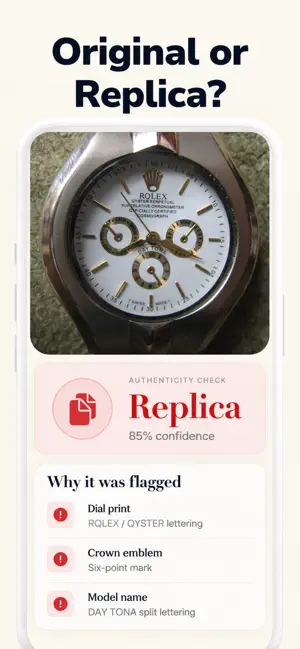


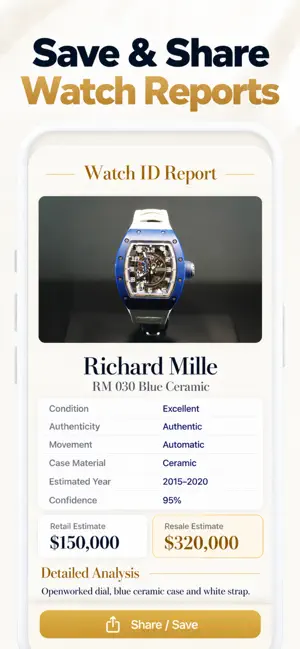
What it does
Brand and model suggestion
Recognizes watches from a photo of the dial and case and suggests the brand and likely model family.
Ballpark value
Turns what it sees into a rough market value range, so you have a number to research from.
Works on listings too
Scan a screenshot of a watch you’re thinking of buying to sanity-check the brand, the model and the asking price.
Points you to the numbers
Shows where to look next — reference, serial, movement — before you pay for an appraisal.
How to identify a watch in four steps
-
Photograph the dial and the case
Shoot the dial straight-on in daylight without glare, then the caseback, the crown side and the clasp. The logo, the dial text and the shape of the hands and markers carry most of the identification.
-
Scan it
Watch Scanner & Valuator suggests the brand and the likely model family and gives a ballpark value range to research from.
-
Find the reference and serial numbers
Look on the caseback, between the lugs (remove the strap or bracelet) and on the inner ring of the dial. The reference names the exact model; the serial dates it. Both formats should fit the brand and the era.
-
Have it opened before you buy or sell
Only a watchmaker can check the movement, the calibre number and whether the dial, hands and bracelet are original — which is where most of the value, and most fakes, are decided.
When to use it
- You’re buying a pre-owned watch online and want to check the model and the price make sense.
- You’re selling a watch and need a starting price before you list it or take offers.
- You inherited or found a watch and don’t know the brand, the model or what it might be worth.
- You’re insuring a collection and want a quick first inventory before a formal valuation.
What a photo scan can and can’t tell you about a watch
| Question | From a photo | Needs a watchmaker |
|---|---|---|
| Brand and model family | Usually | Rare references and limited editions |
| Exact reference number | If engraved and legible | Whether it matches the case and movement |
| Approximate age | Sometimes, from the design and serial | Production year from serial and papers |
| Quartz or mechanical | Hints only (how the seconds hand moves) | Opening the case |
| Original parts | Obvious mismatches only | Dial, hands, bezel and bracelet checked in hand |
| Authenticity | Obvious fakes only | Yes — always for valuable watches |
| Value | Ballpark range | Offer based on verified condition and papers |
Frequently asked questions
Is it a substitute for a professional appraisal?
No — it’s a fast estimate to orient you. For a valuable watch, a watchmaker or specialist dealer should check the movement, the serial and the papers.
How accurate is the value?
It’s a ballpark. Real value depends on the exact reference, the condition, whether the parts are original, box and papers, and current demand.
Which watches does it recognize?
It’s strongest on widely sold models from major Swiss, Japanese and fashion brands; rare vintage pieces, microbrands and heavily modified watches are harder to pin down.
Which devices does it run on?
It’s available on the App Store for iPhone and iPad, and on Google Play for Android.
Can an app tell if a watch is fake?
It can flag an obviously wrong logo, dial layout or model, but it can’t authenticate. High-grade fakes copy dials and engravings well; the movement inside is where they fail, and checking it means opening the case.
How do I find out what model my watch is?
Read the dial and the caseback first, then find the reference number — on many luxury watches it is engraved between the lugs or on the caseback. Search the brand plus that number, or scan the watch to narrow down the model family.
How can I tell how old my watch is?
From the serial number where the brand’s sequence is well documented — Rolex is — and from the papers, the movement calibre and design details such as the font and the hands. Fastemy’s free Rolex serial number lookup dates Rolex serials.
What is my watch worth?
The brand, the reference, the condition, original parts and box and papers decide it. Sought-after steel sports models from a few Swiss brands can hold value close to retail; most other watches resell well below it. Recent sold prices for the same reference are the best guide.
Sources and further reading
- Counterfeiting — Federation of the Swiss Watch Industry FH
- Swiss made — Federation of the Swiss Watch Industry FH
- COSC — Swiss Official Chronometer Testing Institute — COSC
- Counterfeit watch — Wikipedia
Links checked October 15, 2026.
Related reading
The Watch Guide: Movements, Accuracy, Water Resistance and Spotting Fakes — every guide on the topic, in reading order.
Try Watch Scanner & Valuator
Appraise watches instantly with AI-powered scanning.