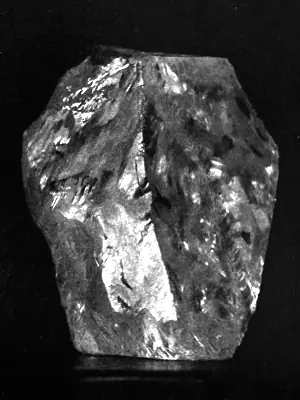
In 1905, a mine superintendent in South Africa spotted something glinting in a wall of the Premier Mine. He pried out a crystal so enormous he assumed it was a worthless piece of glass planted as a prank. It wasn’t. At 3,106 carats — about 1.4 pounds — the Cullinan remains the largest gem-quality rough diamond ever discovered, and the stones cut from it sit at the heart of the British Crown Jewels.
The fist-sized stone
The diamond was named after Thomas Cullinan, the mine’s owner. It was so large that it dwarfed every famous diamond before it — and remarkably clear and colorless. Curiously, one face of the rough was flat, suggesting the crystal may have been part of an even bigger stone that was never found.
A birthday gift for a king
The government of the Transvaal colony bought the diamond and presented it to King Edward VII on his 66th birthday in 1907. To get it safely from South Africa to England, the story goes that a decoy stone was sent under heavy guard on a steamship while the real Cullinan traveled quietly through the regular post in a plain box.
The cut that could have shattered it
Cleaving the giant fell to Joseph Asscher of Amsterdam, the finest diamond cutter of the age. He studied the stone for months before striking it. By legend, his first blow snapped the steel blade, not the diamond; the second split it cleanly along the planned line — after which Asscher reportedly fainted from the strain. Whether or not the fainting is true, the cleaving was a masterpiece of nerve and skill.
From one rough stone came nine major gems and 96 smaller ones — a single diamond turned into a whole constellation of crown jewels.
The Stars of Africa
The two largest stones became legends in their own right:
- Cullinan I — the Great Star of Africa: a 530.4-carat pear-shaped diamond set in the head of the Sovereign’s Sceptre. It was the largest clear cut diamond in the world for decades.
- Cullinan II — the Second Star of Africa: a 317.4-carat cushion-cut stone set in the band of the Imperial State Crown.
The smaller Cullinan stones were kept by the royal family; Queen Elizabeth II sometimes wore two of them as a brooch she fondly called "Granny’s chips."
- Found
- 1905, Premier Mine, South Africa
- Rough weight
- 3,106 carats (~621 g)
- Cut by
- Joseph Asscher, Amsterdam
- Largest stone
- Cullinan I, 530.4 carats
- Home
- Crown Jewels, Tower of London
Got a stone you can’t identify? Diamond Identifier AI estimates a diamond’s size, quality, and value from a scan, and Ring Identifier reads full rings and jewelry — a fast first look before you see a professional.
The takeaway
The Cullinan is the ultimate reminder that the world’s greatest gems start as unremarkable lumps in a mine wall. One enormous, almost-discarded crystal became nine extraordinary diamonds — proof that a single rough stone, in the right hands, can be cut into history.
At a glance
| Fact | Detail |
|---|---|
| Rough weight | 3,106 carats (about 621 g) |
| Found | 1905, Premier Mine, South Africa |
| Cut by | Joseph Asscher & Co., Amsterdam, 1908 |
| Given to the king | 1907, Edward VII’s 66th birthday, by the Transvaal government |
| Cullinan I | About 530 ct pear (530.2–530.4 ct cited) — Sovereign’s Sceptre with Cross |
| Cullinan II | 317.4 ct cushion — Imperial State Crown |
| Where | Crown Jewels, Tower of London |
Frequently asked questions
What is the largest diamond ever found?
The Cullinan, at 3,106 carats, is the largest gem-quality rough diamond on record. Larger carbonado (black, polycrystalline) masses exist but aren’t gem-quality.
How was the Cullinan diamond sent to London?
As a decoy, a heavily guarded package was shipped by steamer, while the real stone reportedly travelled by ordinary registered post.
How many stones were cut from the Cullinan?
Nine major stones (Cullinan I–IX), 96 smaller brilliants and some unpolished fragments.
Where are the Cullinan diamonds now?
Cullinan I and II are in the Crown Jewels at the Tower of London; the other seven major stones are in the personal jewelry of the British royal family.
Sources and further reading
- Cullinan Diamond — Wikipedia
Links checked September 14, 2026.
Explore the apps
Fast, fun, AI-powered apps with 1M+ on the App Store. Find your next favorite.
Browse all apps